
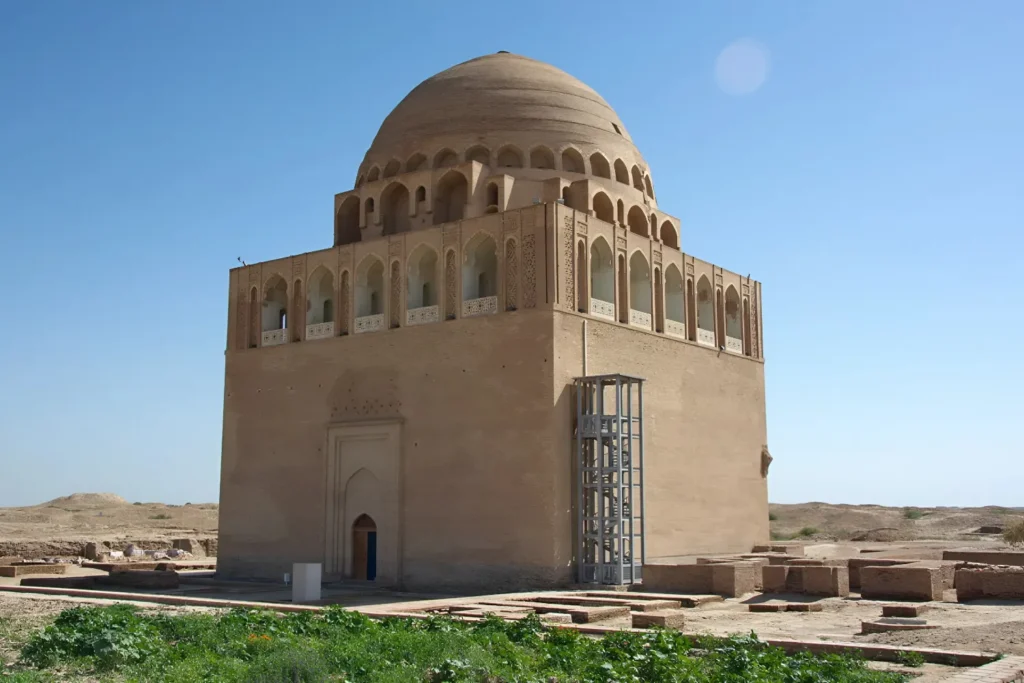
Located in the very heart of the Sultan-Kala citadel, the mausoleum appears to hover over the surrounding ruins. Nearby lie the remains of Seljuk palaces and a majestic mosque. Yet even among these imposing structures, the mausoleum retains its dominant presence.
Majestic Architecture
Before you rises a medieval “skyscraper,” astonishing in both its monumentality and refinement. The cubic structure of the building is crowned with a two-tiered dome clad in turquoise tiles shimmering in the sun. Three-level galleries stretch beneath the dome, and a series of openwork arches forms a captivating pattern.
Symbolically, the dome embodies the sky. It seems to float above the structure, bridging the earthly and the divine. The harmony and symmetry of its proportions are truly admirable.
- The thickness of the walls at the base is 5 m;
- The length of each side is 27 m;
- The total height of the structure is 38 m.
A History Shrouded in Mystery
The mausoleum was erected by order of Sultan Muizz al-Din Sanjar. In 1157, the ruler himself was laid to rest here. Yet the fate of the mausoleum was far from simple. In 1221, during the Mongol siege of Merv, the sultan’s remains were reburied in an unknown location. Today, beneath the tombstone lies only emptiness, but the memory of the ruler lives on in every detail of this monumental structure.
An Arabic inscription has survived on the mausoleum’s façade, telling of the sultan’s greatness:
“This place is ennobled by the remains of one who was called Sultan Sanjar, a descendant of the Seljuk Turks… In his time, he was as just as Alexander the Great; he was a patron of scholars and poets, and he was accepted into the world of Islam in a state of prosperity and happiness thanks to knowledge and art.”
A Place of Attraction
Even today, the mausoleum remains a place of pilgrimage for thousands of believers. For travelers, it is a powerful point of attraction, drawing them in with its mystery and beauty. Here, every stone breathes history, and every curve of an arch tells a story of former grandeur.
A Legend of Love and Magic
Local people tell a wondrous legend surrounding the origins of the mausoleum. It is said that long ago Sultan Sanjar fell in love with a celestial fairy, in the East called a peri. She agreed to become his wife, but only on three conditions…
- He must never embrace her by the waist.
- He must never look at her feet when she is running.
- He must never see her combing her hair.
The sultan accepted these conditions, but his curiosity proved stronger. Breaking all three prohibitions, he discovered that the peri was unlike any earthly woman: she had no bones, she floated above the ground, and her head could separate from her body.
Enraged, the peri turned into a white bird and soared into the sky. The sultan, overcome with despair, cried out, “I will die if I cannot see you again!” The bird replied, “If you wish to see me, you must build the tallest and most beautiful building in the center of the city. Leave an opening at the top of its dome. Every Friday, I will come to look down through it, and you will be able to see me.”
Thus, according to legend, this majestic mausoleum was built, embodying the symbol of unrequited love and eternal remembrance.