
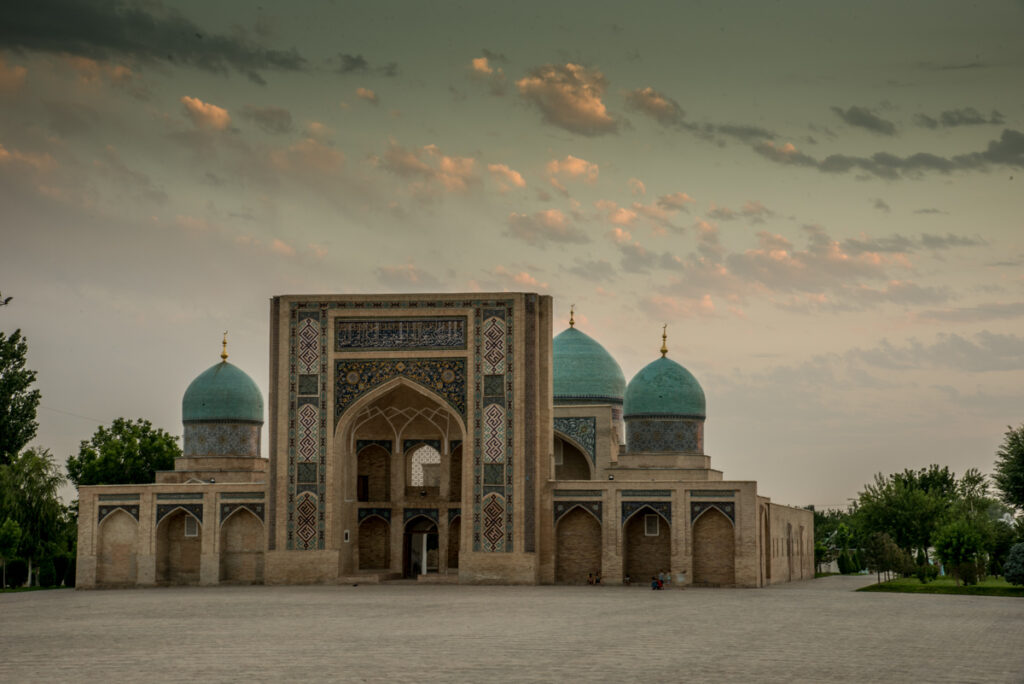
Visitors often ask why guidebooks sometimes refer to it as “Khast Imam.” I always smile. It’s like two names for the same person. “Hazrati Imam” is the formal, respectful version. “Khast Imam” is a more casual name that locals use. Yet both are spoken with the same reverence.
The Square Itself-Prayer Area
On the two main Muslim holidays—Ramazan Hayit and Kurban Hayit—thousands of worshippers gather here for communal prayers. Some say the square can hold over 10,000 people. Others claim it can host up to 15,000.
Right beside the square, on sacred ground, is one of Tashkent’s oldest mahallas. The homes here are over 200 years old and considered part of the city’s architectural heritage. Generations of families have lived here, passing homes from father to son.
Three landmarks stand side by side in harmony: Barak Khan Madrasa, the 19th-century Tillya Sheikh Mosque, and the Museum of the Quran.
The name Hazrati Imam means “Holy Imam.” It is a tribute to Abu Bakr Kaffal al-Shashi, one of the first Islamic preachers in the ancient city of Shash (Tashkent). The ensemble was built around his burial site. The mausoleum named in his honor is located slightly off the main square, closer to the Namazgoh Festive Mosque and the Islamic University.
Completed and opened in 1542, the mausoleum is a single-domed structure with a northern-facing entrance portal. It features two perpendicular axes—a rare architectural solution for its time. One axis runs east-west, the other north-south. Inside is a square hall with the tomb, along with narrow staircases leading to the khanaka—a space for dervishes to retreat and sleep. A second hall was added to the courtyard later.
The Barak-Khan Madrasa was commissioned in 1532 by Navruz Ahmad Khan, the ruler of Tashkent from the Shaybanid dynasty. It was originally intended as a mausoleum for the khan and his father. Later, a madrasah was added, where boys began their studies at 15 and sometimes continued into their 30s, becoming the leading theologians and thinkers of their era.
The Tillya Sheikh Mosque is bright and spacious, with two distinct prayer halls and mihrabs joined by arches. A L-shaped summer ayvan has recently been added.
Housed in the restored Muyi Muborak Madrasa is the Quran Museum, located in a building dating back to the 16th century. It holds one of Islam’s most revered relics—the Quran of Caliph Uthman (7th century). According to tradition, blood stains from his assassination remain on its pages. The Quran is preserved in a climate-controlled sarcophagus, and its authenticity has been confirmed by UNESCO.
It is also believed that the madrasa holds strands of the Prophet Muhammad’s hair. According to tradition, his hair was cut after his death and distributed throughout the Muslim world. The name Muyi Muborak translates as “the sacred hair of the Prophet.”
The ensemble later expanded to include the building of the Spiritual Administration of Muslims of Uzbekistan and a Friday mosque. The Hazrati Imam Cathedral Mosque stands at the entrance of the complex, near the main road. Its minarets are the tallest in the city. According to my teacher, Dilbar Abdunabiyeva, they reach 58.5 meters, though many sources cite 53 meters. The mosque’s floor is covered with a seamless carpet of exceptional beauty, custom-made in Turkey specifically for this space.