
For the first time, a joint archaeological expedition from Uzbekistan and Turkey is excavating the ancient settlement of Shahrukhia near Tashkent—an effort that is revealing new insights into the shared Turkic legacy. Since 2024, a team of archaeologists, historians, anthropologists, and biologists from both countries has been working on-site to uncover the city’s long-buried secrets.
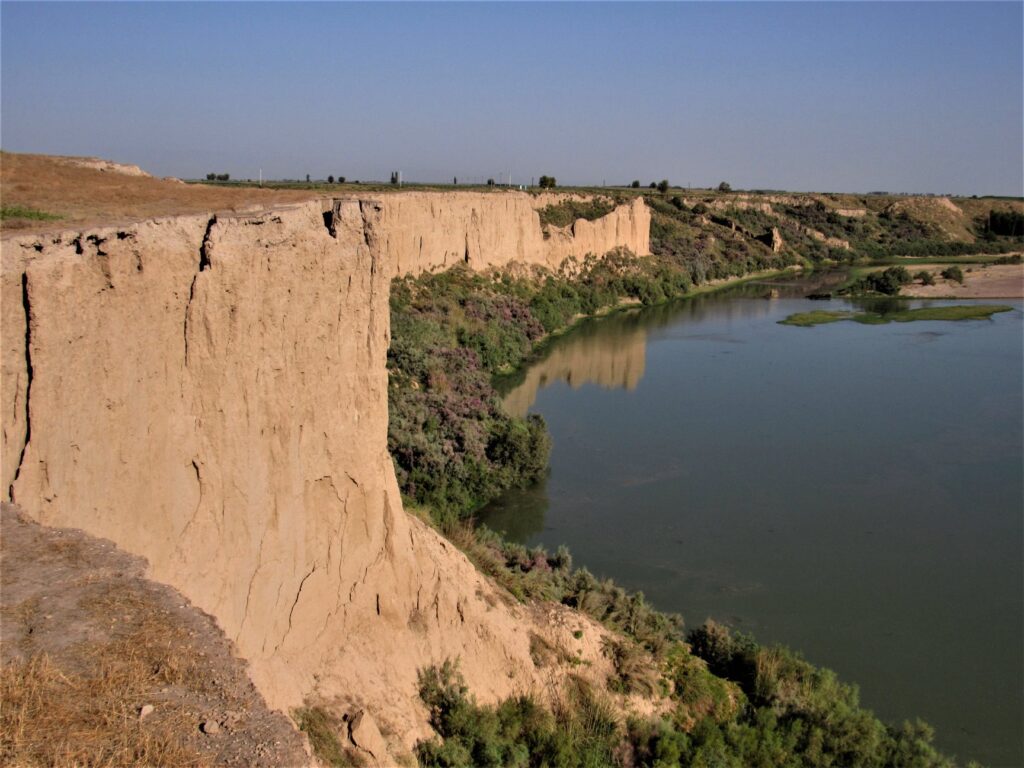
The archaeologists are not only conducting a thorough study of the ancient city’s past—they’re also advocating for its protection. Aware of the site’s historical significance, they propose safeguarding it from erosion caused by the Seyhun River (the medieval name for the Syr Darya) and are working to secure its inclusion on the UNESCO World Heritage List. Currently, the site is on the organization’s tentative list.
The expedition is led by Associate Professor Tuba Tombuloglu of Ankara University, who shared with the world the discovery of the priceless artifacts her team was fortunate to uncover.
Among the most significant discoveries are the remnants of fortifications dating back to the era of Amir Timur, along with fragments that may have belonged to a palace and an arsenal. These finds are accompanied by a trove of equally remarkable relics—helmets, armor, ceramics, glassware, arrowheads, and knives. According to Tombuloglu, the discoveries suggest that Shahrukhia was once one of the region’s major centers for metallurgy, glassmaking, trade, and craftsmanship.
One of the most compelling discoveries is a human skeleton dating back to 1560. For scientists, it’s a time capsule—offering insights into the health, diet, and daily life of people who lived in the city’s golden age.
Researchers now believe that Shahrukhia may have served as a Timurid garrison town. In 1405, on his final military campaign to Otrar, it’s likely that Amir Timur himself stopped here, with his army’s right flank stationed there.
Today, only a third of the ancient city remains—the rest has been claimed by the Syr Darya over centuries. Once spanning 400 hectares, the site is in urgent need of protection, to minimize potential damage in the future.
Dates and Facts About the Great Shahrukhia
The city is roughly 2,000 years old. Originally known as Banaket, it was founded in the 1st century as a fortress naturally protected by surrounding terrain. By the 5th century, it had acquired fortifications, and by the 12th century, it had expanded to 140 hectares, becoming one of the largest centers of trade and craftsmanship. The production of iron and glass goods flourished here, and between the 9th and 12th centuries, copper and silver coins were minted. But in 1220, the city was destroyed by Genghis Khan’s army.
When Amir Timur took control of the ruins in 1392, he renamed it after his son Shahrukh and revived the city’s workshops. From that time until the 18th century, Shahrukhia thrived with the daily life and labor of its hard working residents, until civil strife led to its final decline. Today, only the hills remember Shahrukhia’s distant past, holding many secrets that archaeologists have yet to uncover.
The excavation is still ongoing. The project is being carried out by Uzbekistan’s National Center of Archaeology, in collaboration with the Turkish Historical Society and the Turkish Cooperation and Coordination Agency (TİKA).