This is where the heart of the UAE resides. One should come here for the architecture and design, for the vast repository of memory assembled fragment by fragment, and for the opportunity to witness the devotion with which the nation narrates its own history.
In 2017, at the Leading Culture Destinations awards ceremony, the Etihad was named the best new museum in the Middle East and Africa. The museum is located at 1 Jumeirah Street, on the site of the former residence of Sheikh Rashid bin Saeed Al Maktoum. This is one of the country’s principal landmarks, the place where a decision of historic consequence for the entire nation was made.
First Impressions
Our tour of the Etihad Museum, like our entire visit to Dubai, was organized by the Dubai Department of Economy and Tourism. My daughter and I arrived at the museum ahead of the scheduled time—we had been advised that punctuality was essential.
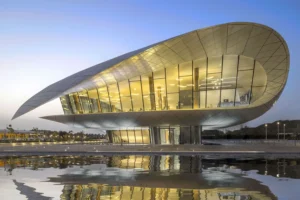
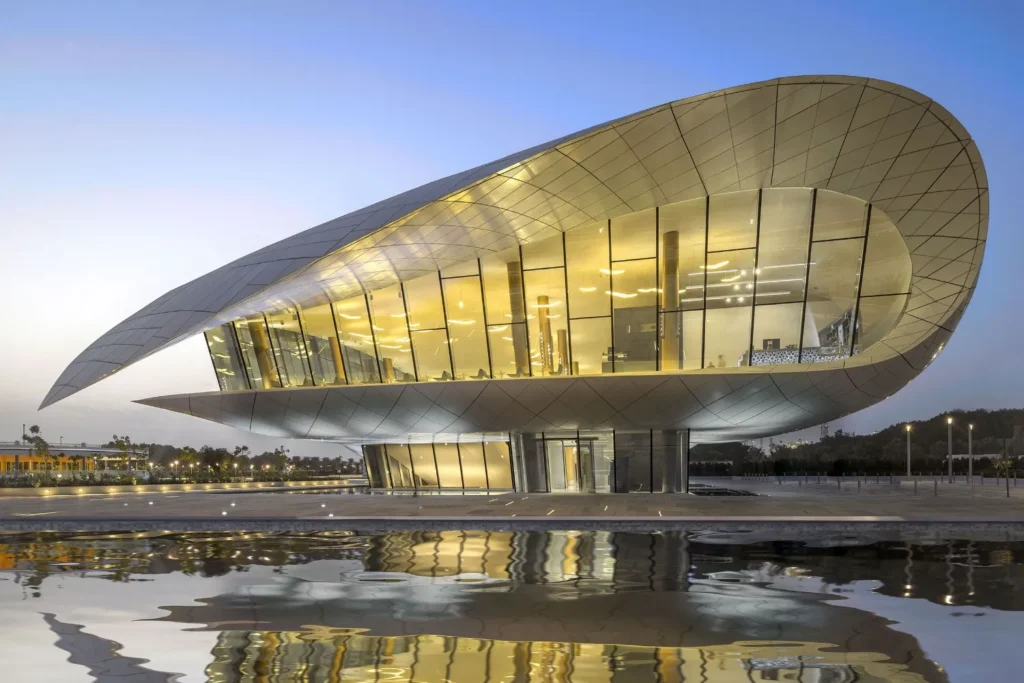
The first thing to capture the eye was the building itself. It resembles a folded sheet of paper, and this is more than a graceful metaphor. As we were later told, the architecture alludes to the Union Agreement, while the seven slanted columns in the pristine white marble foyer symbolize the golden pens with which the constitution was signed in 1971. These meanings do not reveal themselves immediately, yet a sense of history arises even before one steps inside.
While we were waiting for the guide, I approached the panoramic windows. A duck glided across the mirror-like water encircling the building, followed shortly by an entire brood of ducklings. Several other women paused to watch the birds.
Our Tour Guide
We had barely managed to take a couple of photographs when the guide approached us. Ekaterina, as it turned out, was from Tashkent as well. She asked which language would be most comfortable for us. She was wearing a traditional black abaya, her hair covered with a shayla scarf.
Katya has lived in Dubai for twelve years, nine of them working as a guide, and our customary exchange of “how is it here, how is it there” gradually flowed into the presentation of the museum.
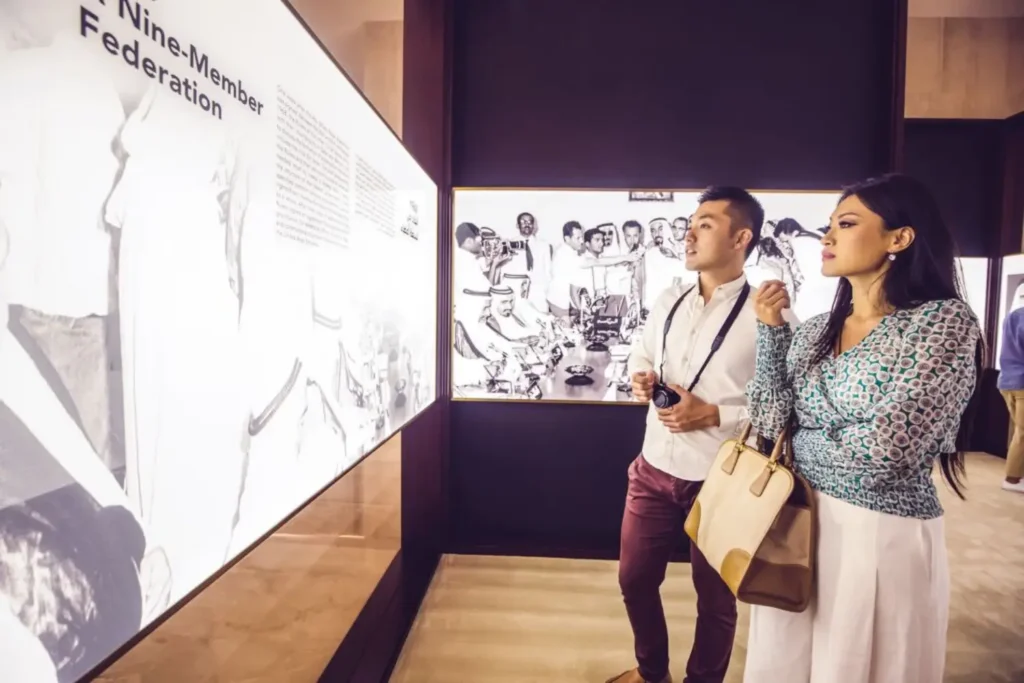
Photo: Visit Dubai
How the Country Was Founded
I appreciated the way the museum’s exhibition tells its story on its own. It all began with Dubai and Abu Dhabi. It was their rulers—Sheikh Rashid and Sheikh Zayed—who were the first to sit down at the negotiating table and decide to attempt an agreement on a shared future. Gradually, the other emirates joined this decision.
Thus, in 1971, a new nation came into being—the United Arab Emirates—while Ras Al Khaimah became part of it slightly later, in 1972.
What You Can See Inside
In addition to the main pavilions, the museum includes exhibition spaces, a library, an educational center, and a restaurant. Among the exhibits are personal belongings, documents, and accessories. These may seem like small details, yet it is they that render history alive. At the beginning of the exhibition, visitors are greeted by large portraits of the seven rulers—and one immediately understands that every decision was shaped by actual individuals.
Ekaterina also spoke about architecture. The building was conceived not as an ordinary museum, but as a representation of the moment the country was born. Light enters through openings of various shapes, and underground passages lead to the Union House—the place where the Union Agreement was signed. Outside, the coastline of Jumeirah as it appeared in 1971 has been reconstructed, complete with a lake and sandy shore.
When we stepped into the park next to Union House, schoolchildren were at the flagpole preparing for a flag-raising ceremony. It was November 3, Flag Day. After the quiet halls of the museum, this felt like a living continuation of history. We waited for the flag to be raised and then continued exploring the city-emirate.
How to Get There
There is no metro or bus service to the museum, so taking a taxi is the most convenient option.
The material was published in Travel+Leisure Central Asia magazine (February-March 2026)