
Plov can rightfully be called an Uzbek brand. No matter what tourists come to see—silk and ceramics, ornaments and domes, waterfalls and snowy peaks, suzanis and doppis, mausoleums and robes—sooner or later, they end up gathering around a plate of plov. All those endless “look left, look right” from the tour guides will soon fade from memory, but the taste of plov and the atmosphere at the table—will never be forgotten.
As for the locals, needless to say—there’s a proverb: “he who has no money eats plov, and he who has plenty eats plov every day.”
In every dining hall, there’s a wide selection of dishes—and there’s always a kazan with plov. And in the countless “Milliy Taomlari” eateries, the kazan (cast-iron cauldron) is opened at 11 a.m. sharp, and by 1 p.m., the plov is usually gone.
There are many “plov communities” with daily discussions, endless videos and recipes online—everything has been said and retold, and yet the urge to talk about this beloved dish never fades. Many legends surround its origin, tied to the names of Alexander the Great, Amir Temur, and Abu Ali Ibn Sina, since there are no other famous historical figures and all the myths are linked to them. The only thing one can agree with is the words attributed to Ibn Sina (Avicenna) about the benefits of plov: he supposedly recommended it for gastritis and other digestive disorders, since the combination of rice and carrots has a positive effect on the body.

Legends also often circulate that plov arrived to us with caravans from Persia or China. Considering the regions where rice is a dietary staple, it’s entirely possible that rice arrived here from South or Southeast Asia (or maybe even from us to them?), but that doesn’t necessarily mean plov itself was imported, it’s obvious: adding vegetables and meat to boiled rice is something people everywhere must have done—what exactly is there to import? Plov is found in Afghanistan, Iran, and Azerbaijan—and there are similar rice-based dishes in other countries too. The point is that our love for plov will neither grow stronger nor weaker because of discussions about its origin—though, of course, it’s always a pleasure to talk about.
For further reflections on this beloved dish, let’s narrow the field, leaving out Afghan plov with prunes, Azerbaijani with dried apricots, Russian, Belarusian, and Baltic porridges passed off as plov, as well as all kinds of risotto, paella, sushi, puddings, and bibimbap. Let’s limit ourselves to Uzbekistan.
A few years ago, a plov festival was held at Ḉinara’s restaurant, where master oshpaz chefs prepared plov from different regions of Uzbekistan in large kazan cauldrons. The festive Tashkent version won by a wide margin as the most familiar—for a huge number of diners, this variation represents the very essence of “plov.” When we order plov in cafés, restaurants, or teahouses, this is the version we expect to see. The rice is long-grain lazer, steamed, light, and fluffy, with each grain infused with oil (a blend of dumba, sunflower, and/or cottonseed oil), the meat is cooked in large chunks and sliced into pieces before serving. All other versions are best considered in relation to the Tashkent style not because they’re any less worthy, but simply because it makes comparisons easier.
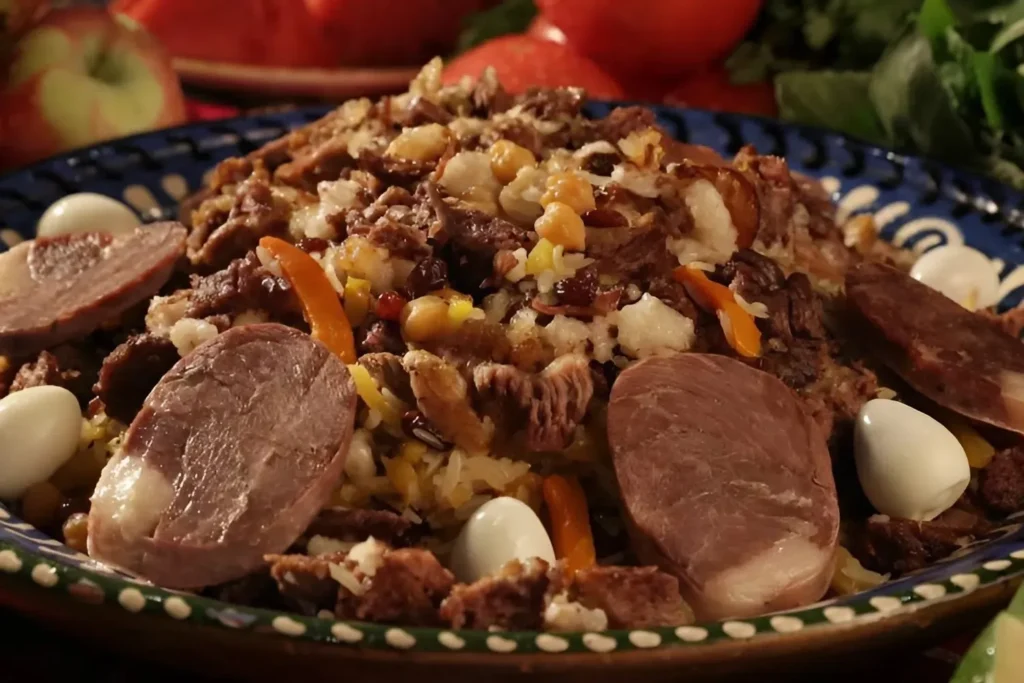
Photo: Aleksandr Borisov, courtesy of the Museum of Plov
Bukhara-style plov is traditionally prepared in a thin-walled copper kazan. The copper was lined with tin, which made frying impossible—the tin would melt and everything would burn because of the thin walls, that’s why the rice, meat, and carrots were boiled separately, then combined and topped with oil. The result is delicious, and for those who grew up eating this style no other will do. Later, cast-iron kazans appeared (and now even aluminum ones), allowing the meat and onions to be fried, in doing so, aromatic high-molecular compounds are formed, tempting both the sense of smell and taste; as the plov cooks, they dissolve into the broth (zirvak) and are absorbed by the rice, creating that unforgettable feast of flavor.
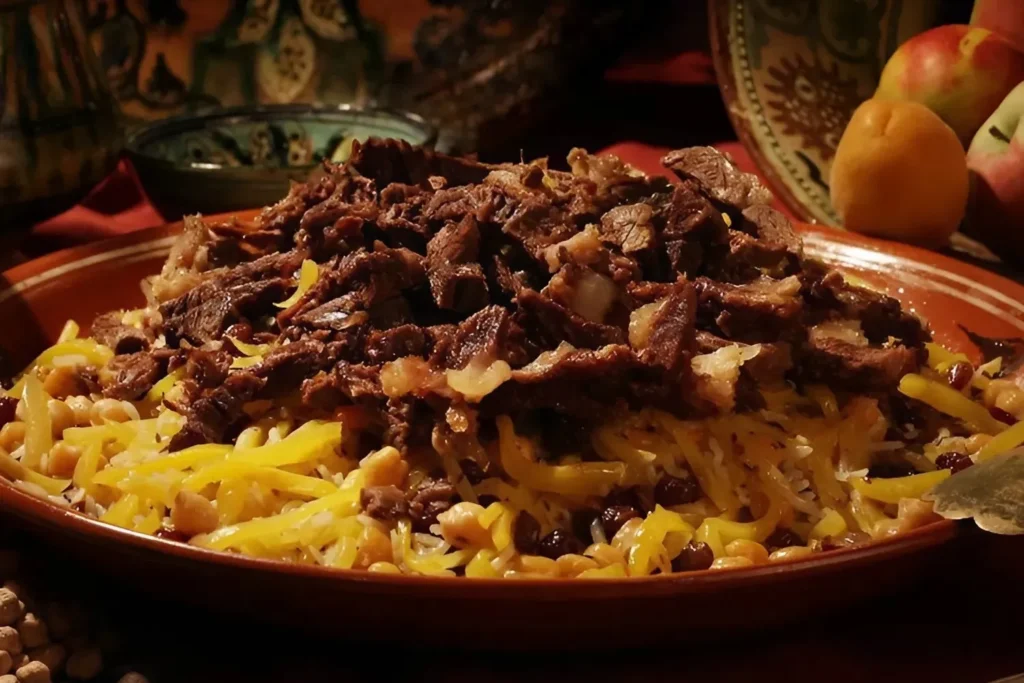
Photo: Aleksandr Borisov, courtesy of the Museum of Plov
In the Khorezm version, the carrots are cut into slices rather than sticks, and no spices are added to the plov. This variation, tasty in its own way, is valued and well-known in Khorezm and Karakalpakstan. The Bukhara and Khorezm styles of plov are considered exotic in the capital, and it’s not easy to find or try them. What’s easy to find, by contrast, are the two dominant branches of plov—the Samarkand and Fergana styles.
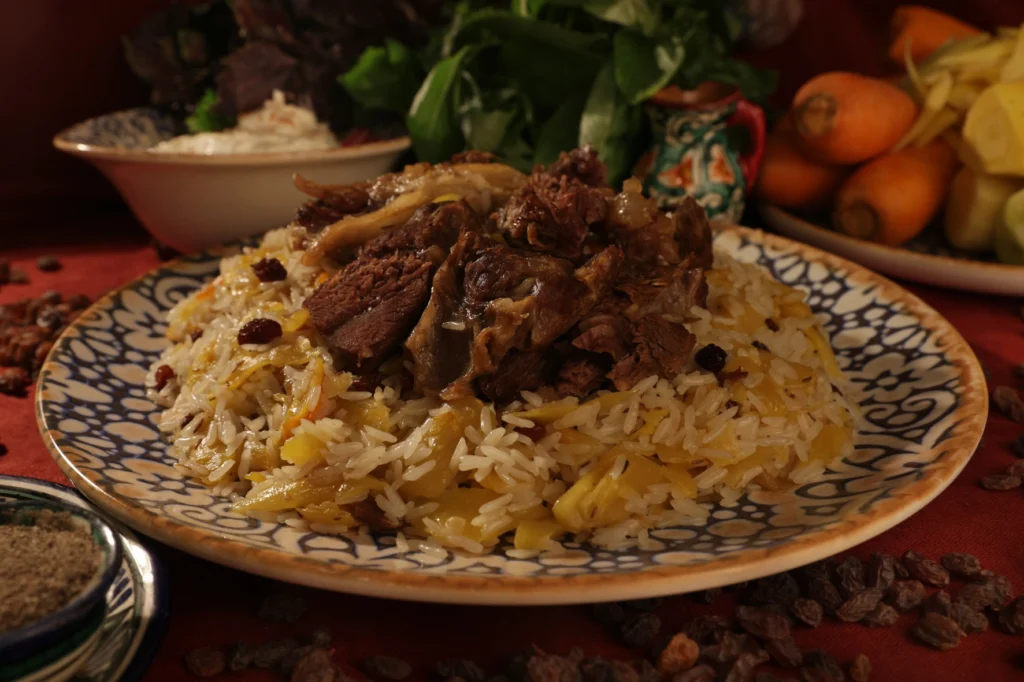
Photo: Aleksandr Borisov, courtesy of the Museum of Plov
The Samarkand-style is cooked using “zigir” oil; it’s a blend of flaxseed, sesame, and other oils prepared in a special way. Its appearance may seem alarming to Europeans: a black liquid resembling diesel mixed with fuel oil. Nevertheless, the plov is neither heavy nor unhealthy, as the oil is rich in vitamins. The main feature of Samarkand plov is that it isn’t mixed but layered: rice at the bottom, carrots on top, and meat above them. The advantage of this serving style is that each spoonful can be “constructed” with different proportions of ingredients, allowing you to enjoy a new flavor every bite.
The Fergana version, made with devzira rice, stands apart, the people of the Valley recognize only this style. This rice is usually fermented (dried) for several years, developing a distinctive flavor. It can be dark (from deep brown, like the “kora-kiltirik” variety, to light beige, like “chungara”), but the dark powder washes off during rinsing. When soaked and cooked, devzira expands in volume and, when served on a lyagan (large platter), visually “overpowers” the carrots and meat. To the people of Fergana, this is exactly how it should be; to Tashkent locals, however, it seems that devzira steals the spotlight—but in the end, everyone enjoys the plov with equal delight. There are also variations: Kokand-style (served with a piala of spicy broth from the kazan), Rishtan and Andijan styles, each with its own unique subtleties.
Each variation could fill an entire book: which oil to use (sunflower, cottonseed, dumba, olive, clarified butter, grape seed, corn, horse fat, etc.), which meat and which cuts, whether to chop it coarsely or finely, what to fry first—onions or meat, which carrots to choose (red or yellow), which type of rice (lazer, alanga, kenja, devzira, avangard, and others), whether to soak it or not, and, of course, the add-ins (chickpeas, peppers, garlic, barberries, cumin, turmeric/saffron, quince…)—an endless song.
In my opinion, the most delicious plov is the “chaykhana” style—the meat is cut into small pieces (about half the size of a matchbox), the onions are fried intensely, almost to the point of charring, and the rice turns out dark, but most importantly, the rice shouldn’t be soft (as grandmothers tend to prefer)—it should be firm, offering resistance when you chew, so you can almost “get tired from the pleasure”—a true dream for strong, rugged men.
The Jizzakh version is also wonderfully good, especially with pistachio kernels—find a place where they make it and see for yourself, you won’t regret it. And there’s more… but it’s time to wrap up.
The material was published in Travel+Leisure Central Asia magazine (Autumn 2025)