
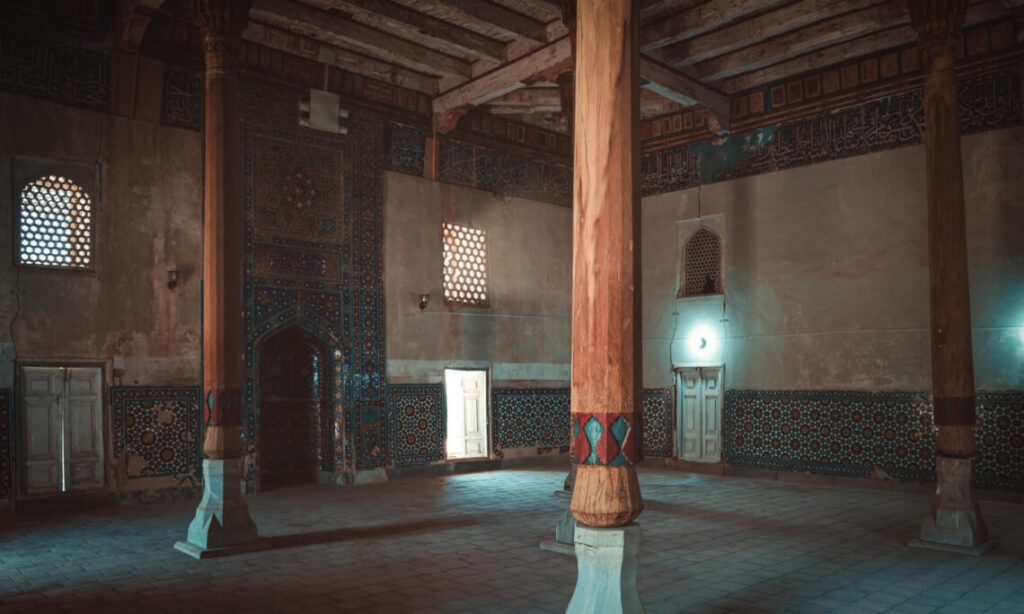
Hidden from the hustle of the world and the popular tourist trails of the Great Silk Road, this sanctuary welcomes those in search of peace and tranquility.
The mosque and mausoleum, which form the heart of the complex, were built in 1448. Until recently, they hadn’t undergone any major restoration, and while time was kind, it left its marks. Recognizing the need for urgent preservation, the University of Chicago’s Institute for the Study of Ancient Cultures led a major restoration project. Experts reinforced the ancient foundation, stabilized the delicate tilework, and replaced the weathered roof. The project’s total cost was $250,000.
Today, Langar Ota—one of Central Asia’s greatest monuments—once again opens its doors to visitors. Here, you’ll hear fascinating local legends and uncover the secrets of this sacred treasure. Interestingly, the keepers of these stories—the humble, hardworking people of Langar—are known for their longevity. In this village, living to 100 is nothing out of the ordinary.
The Home of a Renowned Sufi Brotherhood and Other Facts About Langar Ota
Langars are architectural and burial complexes. According to various sources, there are between seven and fourteen of them across Uzbekistan. The word itself has several meanings, all united by a common idea: “anchor,” “anchor of salvation,” “haven,” “refuge,” “abode of Sufis,” “last hope.” In modern interpretation, “langar” is often translated as “the dwelling of God on Earth.”
Langar Ota is renowned for its Timurid-era tilework and the intricately carved wooden columns supporting its arches. The complex holds great spiritual significance as a pilgrimage site connected to the Ishqiya Sufi order, which found refuge in Mawarannahr between the 15th and 17th centuries. The brotherhood practiced strict asceticism, remained indifferent to wealth and worldly pleasures, and was known for the purity of its heart and intentions. The core idea of Ishqiya was to live in service and love of Allah.
The mosque was once home to an invaluable Islamic relic—the Katta Langar Quran, created in the 8th century. It is one of the oldest surviving Qurans written in Kufic script. For a long time, it was believed to be the original “Quran of Uthman,” written by the hand of the third Righteous Caliph. Today, its surviving pages—said to be stained with his blood—are kept at the Muslim Board of Uzbekistan in Tashkent.
Elders of Langar will show visitors two ancient stones, “male” and “female,” which have rested in the mosque’s courtyard for centuries. They are said to “measure” a person’s sins. According to legend, these stones—weighing 135 or 51 kilograms— must be set upright. It’s said to be easy to do if your soul is pure and free from sin.
… To reach this blessed place, you’ll need to cover over 400 kilometers from Tashkent. Once the steppe gives way to mountain peaks, the air turns crystal clear, and the silence becomes surreal to an urban ear—that’s when you’ll know you’ve arrived.