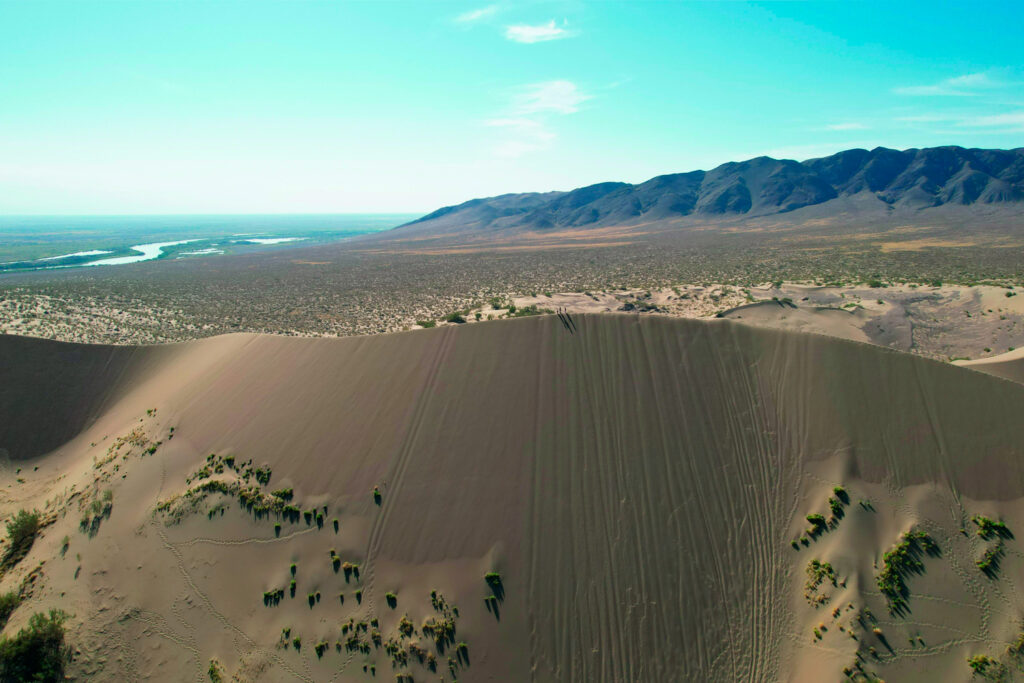
I’m sure everyone dreams of an adventure that’s not just Instagram-worthy, but one that lives on as a vivid memory—with dust on the wheels and a road leading nowhere. My boyfriend and I, along with his family, decided to spend the weekend just like that. Not sunbathing at a Kapchagay resort, but embarking on an improvised mini road trip. The plan was simple: a wild beach with the Dune, the Nomad City, and the Lighthouse. Just three stops—what could possibly go wrong?
First stop: Dune Beach
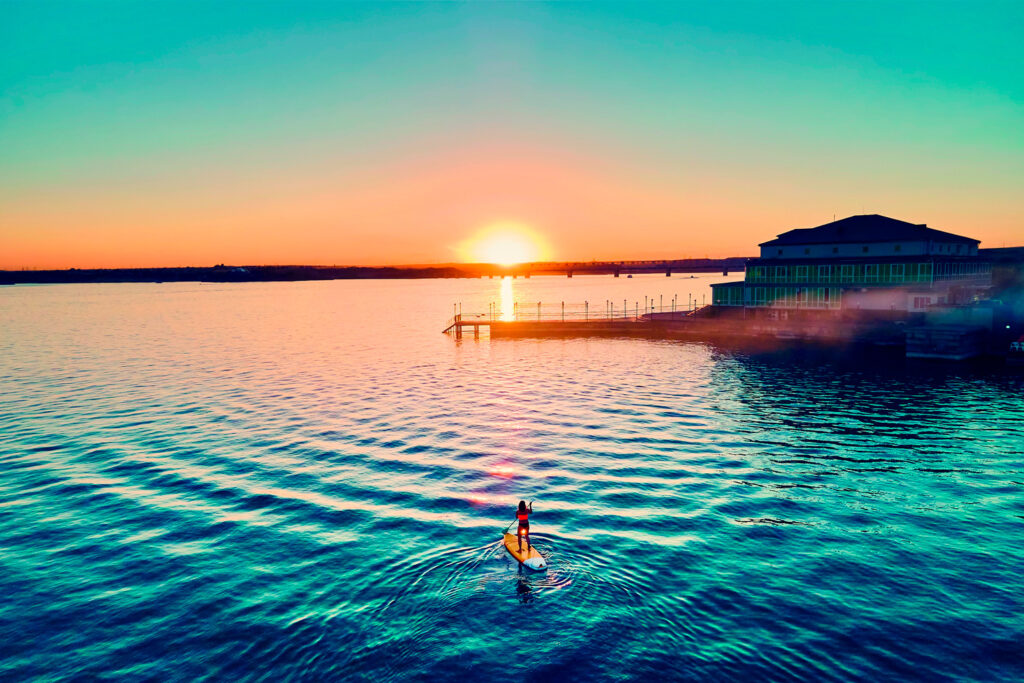
Photo: pikoso.kz
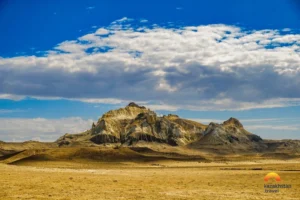
Waves of sand dunes, scorching-hot sand, and rows of cars parked right on the shore. My bare feet sank into the burning sand like a spoon into a sugar bowl. On weekends, entry by car costs around $15.50, or $2 per person if you leave your car outside the area.
According to the plan, we intended to leave my boyfriend’s mother under a beach umbrella and head off to explore the surroundings. But a recent storm had its say: the umbrellas had been scattered across the dunes, and rentals were temporarily suspended. The parking lot was packed, like a city-wide festival was about to kick off. We expected a full house, but half of the visitors just strolled along the shore and left. We stayed—and we didn’t regret it.
A pristine beach, damp sand underfoot, no seaweed in the water, a swing at the top of a dune, the endless surface of the Kapchagay Reservoir, and wind carrying grains of sand beyond the horizon. There were far fewer people in the water than cars in the parking lot.
We made a makeshift sunshade in the shadow of the car hood. Mom stayed behind to enjoy the beach, while I headed for the top of the dune—where a swing offered a stunning view of the lake. I wanted to climb up there, even though the sand scorched my feet and clung to my skin. Standing at the top, wind in my face, I felt it for the first time—this was a real journey. Not a guided tour, not a planned itinerary—just like in the movies, only real.
Nomad City
On the way to the “city,” we endured a quest. First, a smooth highway, then, brutal off-road. Stones, potholes, dust. At some point, we all went quiet in the car—only the music and mom’s yelps over the bumps broke the silence. But we had the persistence to make it to our destination, after which parents went for a swim in the Ili River, and my boyfriend and I headed into Nomad City. Entrance fee is around $2.80 per person.
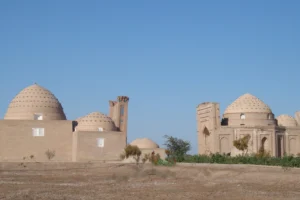
The “city” is a film set built for the 2005 movie Nomad, and though the walls weren’t meant to last forever, the atmosphere still lingers. Now it’s slowly crumbling. There was something magnetic about it. As I walked along a wooden plank to get a city view from above, Jah Khalib’s song Medina started playing in my head—its music video was filmed here too.
We were pretty worn out. We took photos mechanically, without much enthusiasm, but with a sense that one day, we’d look back at them with nostalgia. The city’s fortress was aging, but still holding on. The stone was crumbling, the wooden structures creaked. The place breathed with memories of what once was.
Our final stop was going to be the Lighthouse.
Lighthouse

Photo: Alen Kleinbok
We missed the necessary turn. And there were no other forks in the road, so the trip I’d promised my editor didn’t happen. I was disappointed, but then I remembered someone else who could tell me about that place.
My friend Alen Kleinbok had made it to the Lighthouse earlier and told me: “The Lighthouse is decorative, two stories tall, it’s more of a photo spot. But there’s a beautiful pier nearby. The place has a great vibe. I used to come here with my grandfather to eat shashlik—the best I’ve ever had. Now the shashlik stand is gone, but the place still lives on.” Entrance to the beach costs around $3.90 per person, or about $5.80 if you plan to stay and swim. Parking is free. You can find the Lighthouse on 2GIS under the name “Пристань” (Pier). There’s a local café called Karlygash where you can grab a bite. The average check is about $9.70–$11.60 per person. Next door is a stand-up paddleboarding club, 727 Sup, where $9.70 gets you 1.5 hours on the board. The place—a backdrop for stories.
Alen was left with mixed impressions: “What stuck with me was a shepherd with camels and a dog that approached me. I imagined how there could’ve been yurts here—you could rent a costume, take photos, try kumis or shubat… But instead, there was only silence and wind.”
We returned home tired, windswept, and with sand in our travel bag, as if we’d brought a piece of the journey back with us. What remained were the scent of the dunes, the sound of the swing over the lake, and a sense of motion that lingers, even after the road ends.
We didn’t get to see the Lighthouse. But perhaps that’s even better. Every trip should leave something unfinished—so there’s a reason to come back.
If you decide to follow the same route, take note: it’s best to split the journey over two days and give each stop a chance to fully unfold.