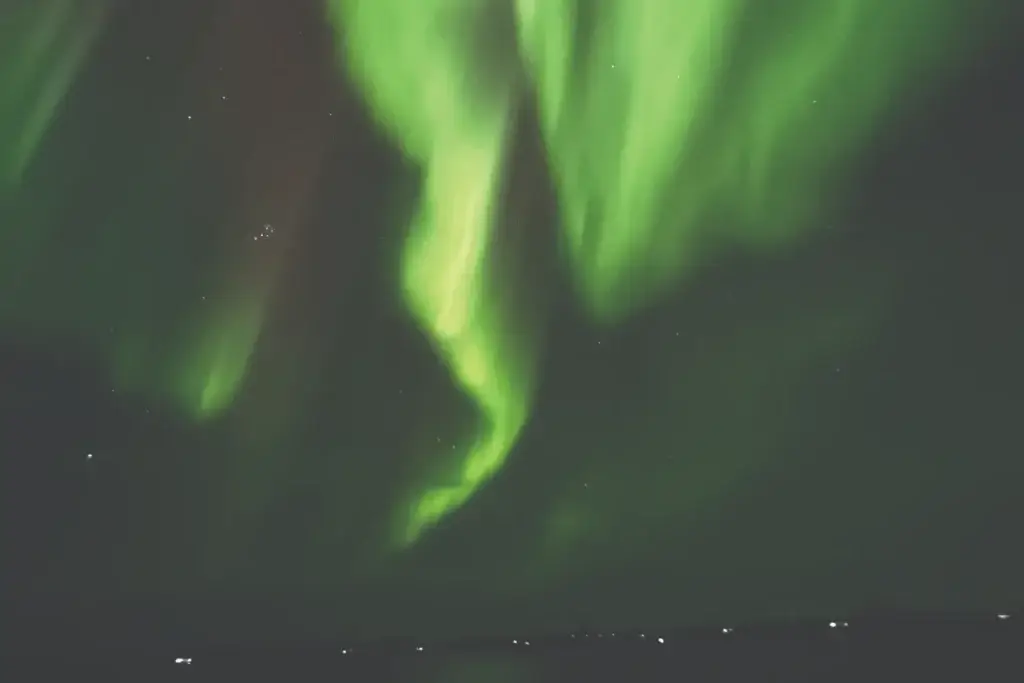
To catch the Northern Lights, several factors have to come together at once: you need to be as far north as possible, closer to the Arctic Circle, wait for clear skies, and stay away from city lights. I usually get lucky — on my first trip, we saw the aurora on four out of six nights. This October, I’ve already traveled with groups twice, and both times we were fortunate. There are apps that show aurora activity in real time, but there have been moments when the forecast was only 1–2%, and suddenly the sky lit up with green waves of light.
I’ve visited more than 50 countries, and Iceland still holds first place for me. On such a small island, there are an unreal number of breathtaking locations: volcanoes, glaciers, two oceans, whales, hundreds of waterfalls, geysers, the Northern Lights, and black sand beaches. And all of this can be seen in just one week. Add to that perfect roads and cozy cafés with delicious food.
But the aurora can be seen not only in Iceland. In December, we have a tour planned to Teriberka — a settlement near Murmansk, beyond the Arctic Circle, on the shore of the Barents Sea. We’ll be going there with a group to hunt for the Northern Lights again. The difference is that in Iceland, even if you’re unlucky with the lights, you’ll still experience incredible nature. However, it’s an expensive country — even more expensive than Switzerland. Our tour cost $3,100, plus flights and a Schengen visa.
The hardest part is the preparation: gathering people, organizing everything, and explaining that this is not just a vacation, but a journey almost into another world. It’s active, but not exhausting. On the contrary, it fills you with energy.
If I had to describe the aurora in one word, it would be “cosmic.” The key is not to go for just one or two days, but to allow extra time in case of bad weather. And, of course, dress warmly — sometimes you have to wait for a long time, out in the cold.
The article was published in Travel + Leisure Central Asia (December 2025-Janary 2026) under the title “ The Cosmos Overhead.”