
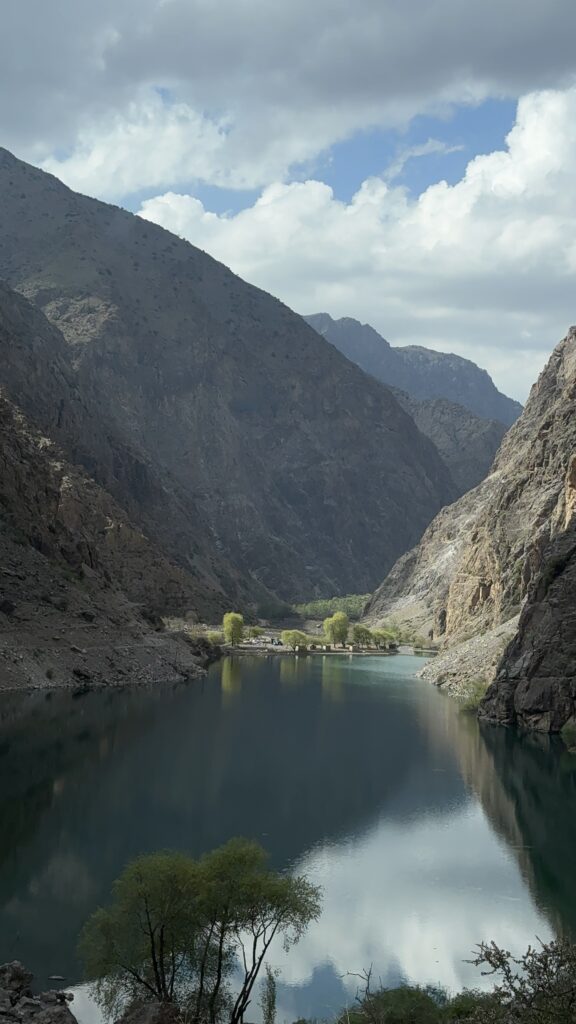
But a little farther up, another marvel reveals itself—Soya Lake, the name of which translates from Tajik as “shadow.” The lake lies in the shadow of towering cliffs, and sunlight barely lingers on its surface. Even in the heat of a summer afternoon, its water remains cool.
Soya is the second lake in the Marguzor chain, perched at 1,701 meters above sea level. We reach it on foot or by off-road vehicle, following a winding mountain path for two kilometers.
The lake is relatively small—about 570 meters long and up to 217 meters wide at its northern end. The lake’s water is like a living organism that constantly shifts its mood. Everything depends on the sky and the light. It responds to the weather, to clouds and overcast skies, and reflects it all like a mirror—just as it is.
Tourists sometimes ask, “What are those stones near the shore, and why do they sparkle like that?” These are what we call “metallic stones.” Minerals on the lakebed refract light, making the depths shimmer. Children fall silent in awe, adults pull out their phones, and I simply gaze. Because though I’ve seen it many times before, Soya Lake reveals a new kind of beauty every time.
From the west, a stream called Anangoran flows into the lake. This delicate thread of water adds a sense of motion, making the lake feel alive, even as it remains perfectly still.