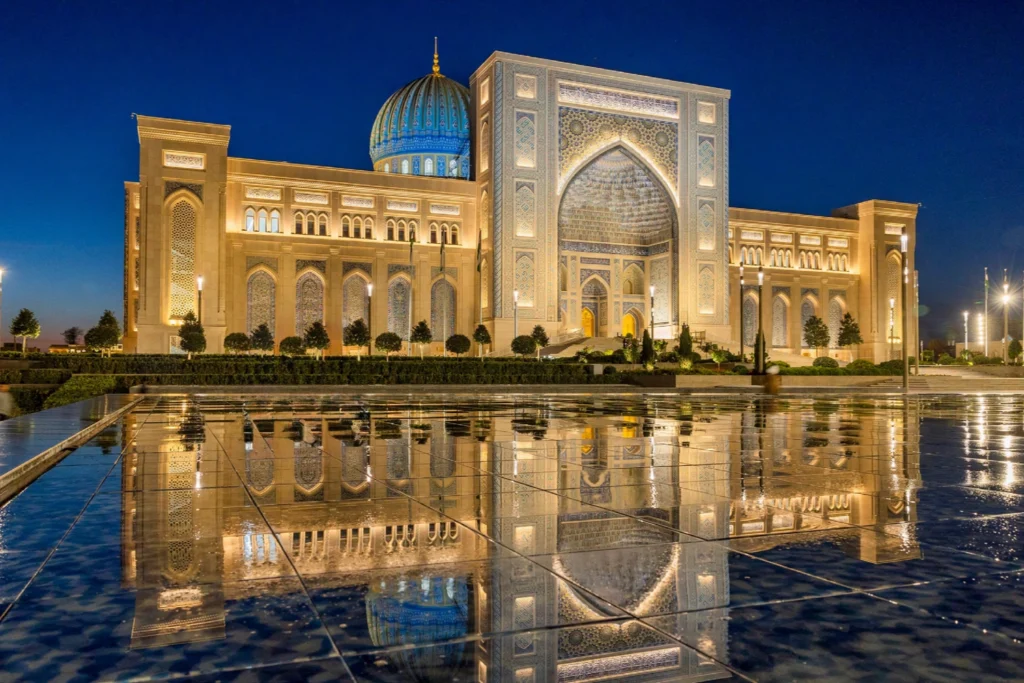
Nearly ten years of discussions, research, and preparation. Thousands of artifacts gathered from museums, archives, and private collections around the world, reflecting more than two millennia of the region’s history and the formation of its culture, science, and spiritual life. Even now, it is clear that the Center will become one of the most significant and large-scale cultural spaces in the region, combining a museum with an educational and research complex.
Entering through one of the four monumental portals immediately immerses visitors in different historical eras. Each hall represents a distinct historical period, while the spacious atrium with fourteen arches sets the scale and conceptual logic of the entire complex from the very first steps. Guests are introduced to the Center by digital avatars of more than 100 outstanding scholars and thinkers of the past.
The first section of the exhibition is dedicated to the pre-Islamic heritage of Central Asia. It brings together archaeological discoveries, petroglyphs, bronze artifacts, ancient writing systems, and everyday objects. Digital reconstructions bring early settlements, trade routes, and proto-urban cultures to life, illustrating the formation of the region as a cradle of civilization long before the emergence of Islam.
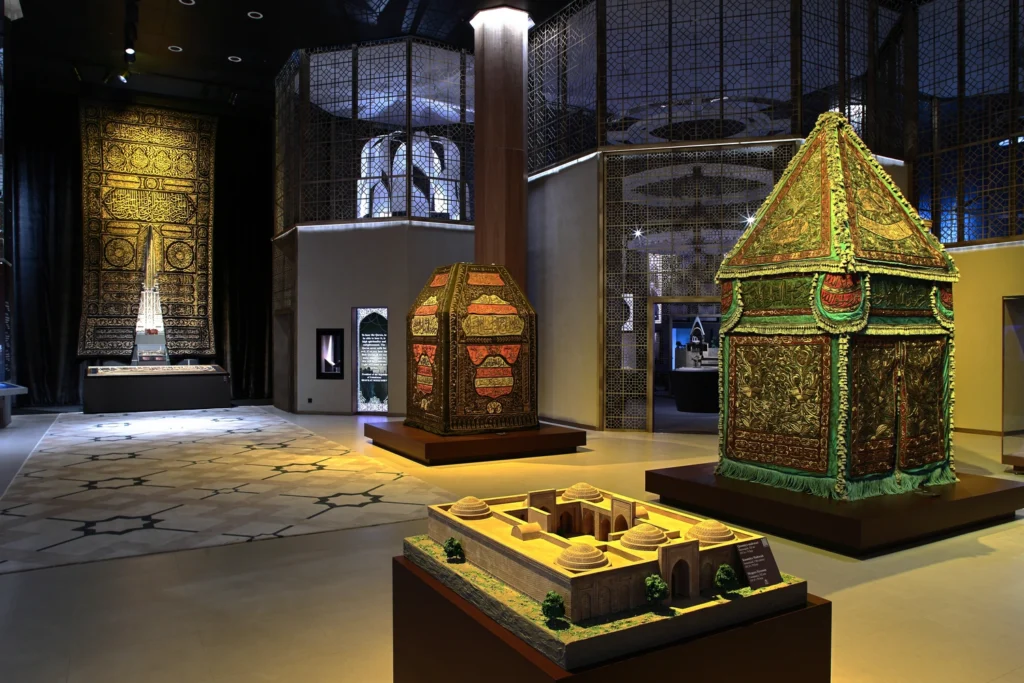
Photo: Center of Islamic Civilization
The Hall of the First Renaissance covers the period from the 8th to the 13th centuries and is devoted to the scientific revolution of the Islamic Golden Age. Interactive reconstructions of the House of Wisdom, holographic demonstrations of achievements in algebra and astronomy, and AI-driven avatars of scholars such as Ibn Sina and al-Khwarizmi reveal the development of mathematics, medicine, astronomy, and philosophy.
The Hall of the Second Renaissance focuses on the Timurid period – an era of artistic flourishing and scientific accomplishment centered in Samarkand and Herat. Visitors can explore models of iconic architectural monuments, illuminated manuscripts, miniatures, and multimedia installations that reflect the intellectual life of the Timurid courts. Between the halls, interactive screens invite visitors to enter their names and see how they would have appeared in Sogdian, Persian, or other ancient languages, depending on the hall and the historical era.
Particular attention is drawn to the immersive zones that recreate traditional Eastern bazaars. On the screens, merchants offer spices, fruits, and sweets, and one cannot help but feel as though they are standing amid the lively bustle of historic market rows.
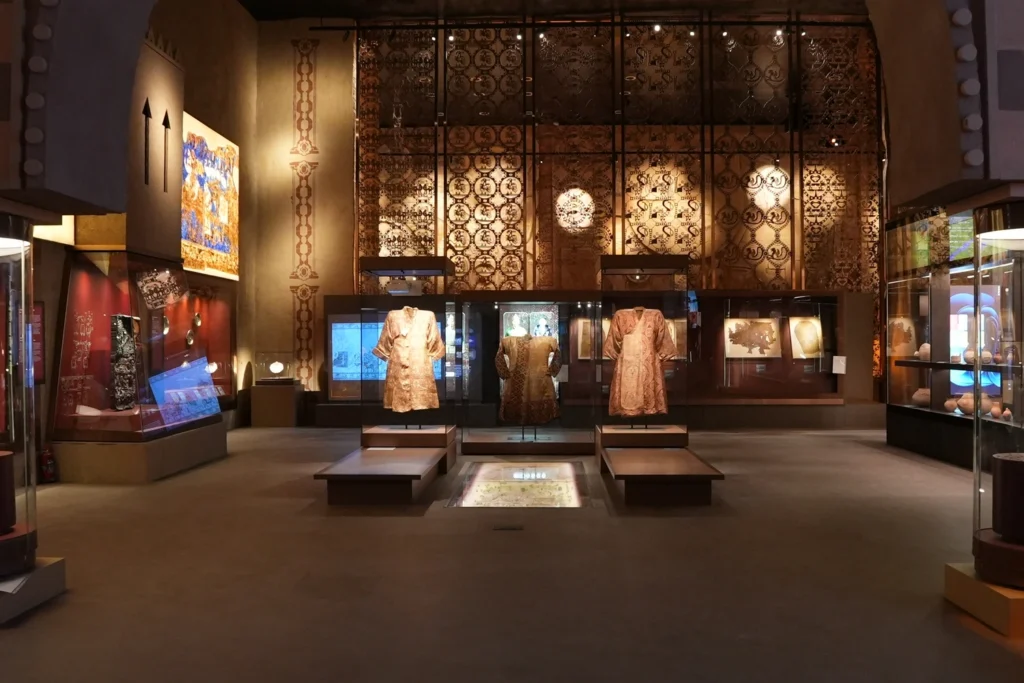
Photo: Center of Islamic Civilization
The historical narrative flows seamlessly into the present day. The exhibition of the Third Renaissance features a wealth of digital and VR formats, as well as visual narratives dedicated to culture, education, and scientific development. Here, past and present move forward hand in hand.
The journey concludes in the Hall of the Quran. At the center of the octagonal space, illuminated by light streaming from a soaring dome, is preserved the Uthman Quran – one of the seven oldest surviving handwritten copies of Holy Quran, included in UNESCO’s Memory of the World Register.
Beyond its exhibitions, the Center houses restoration laboratories, a digital manuscript archive, and educational programs for children and young people, as well as schools of calligraphy and traditional arts. Located adjacent to the Hazrati Imam complex, it will be open daily from 9:00 a.m. to 6:00 p.m. The exhibitions are available in Uzbek, Russian, English, and Arabic. The interior also features a café, a souvenir shop, family areas, and prayer rooms.
5 remarkable artifacts at the Center of Islamic Civilization
A fragment of the Quran copied by calligrapher Umar Akta for Amir Timur
(Central Asia, late 14th–early 15th century)
A monumental example of Timurid calligraphy, executed in bold, assured script designed for reading from a distance. Gilded ornamentation and decorative motifs emphasize the ceremonial character of the manuscript, likely intended for use in major religious centers or during significant state ceremonies.
Ibn Sina’s manuscript of the Book of Healing (Liber Sufficientia)
(Timurid era, 13 March 1493)
An early, fully preserved copy of Ibn Sina’s encyclopedic work Kitab al-Shifa. Precisely dated to Friday, 5 Jumada al-Ula 898 AH / 13 March 1493. An outstanding example of the scientific manuscript culture of the Timurid period.
Exceptionally rare bronze finial with silver inlay
(Central Asia, 12th–13th centuries)
This object is adorned with teardrop-shaped cartouches featuring zoomorphic motifs and geometric ornamentation. Inscriptions include the name of the artisan (‘‘made by Muhammad Ahmad) and likely indicate the patron—the Seljuk ruler Ghiyath ad-Din Muhammad.
Marble fountain element with fish motifs
(Central Asia, 12th century)
An eight-sided recess intricately carved with eight fish, symbolizing abundance. The outer band is decorated with birds and vegetal motifs, reflecting the harmonious interplay of natural and aquatic elements.
Courtly Central Asian shamshir
(Kokand, 19th century)
A ceremonial sword of the Kokand Khanate, lavishly adorned with gold, turquoise, and precious stones. Indicative of aristocratic or ruling-class ownership, it served as part of ceremonial military regalia.
The material was published in Travel+Leisure Central Asia magazine (February-March 2026)