
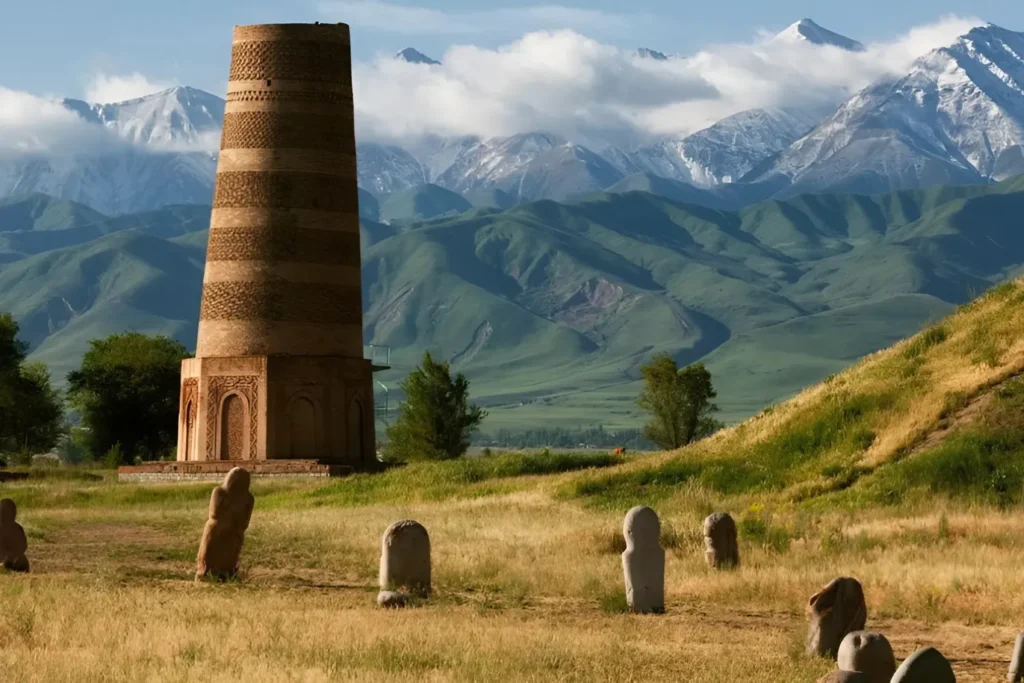
The tower is the most visible trace of the ancient city of Balasagun (or Balasagyn), which during the time of the Karakhanid Khanate occupied a huge territory of 30 square kilometers. Excavations have revealed to the world the remains of a fortress, workshops, bazaars, baths and even arable land. Water was supplied to the city through a large pipe from a nearby canyon. But with the arrival of the Mongols, the city began to fade away – and by the 15th century it had turned into a real ghost town.
According to various sources, the tower was built in the 9th–11th centuries and served as a minaret. It used to amaze with its height ‑ as much as 24.6 meters! However, fate decreed otherwise: presumably in the XV century, an earthquake destroyed the upper half of the structure. Today‑ the preserved part of the tower is still impressive and remains a striking example of early Islamic architecture in Central Asia.
Walking around the area around the tower, you will see ancient stone sculptures – balbals. These 6th century Turkic tombstones symbolized ancestors and warriors. There are also stones with petroglyphs from the 2nd century and brick mausoleums. And in the local museum you can learn even more about the history of these places.
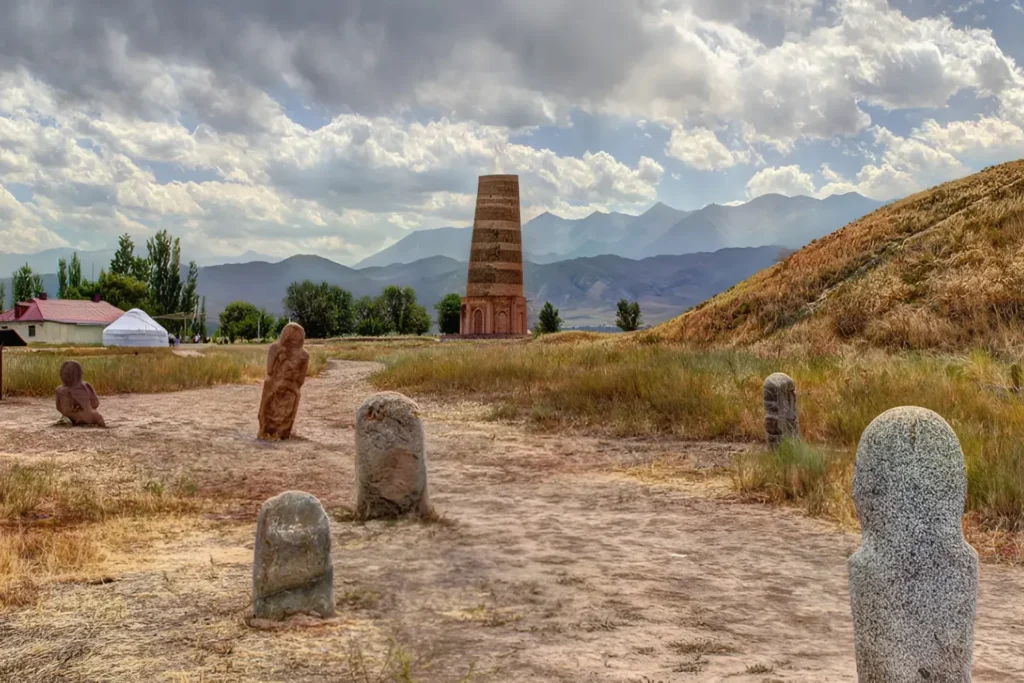
But the most exciting part awaits those who decide to climb the restored internal staircase of the tower. From the height, a stunning panorama of the Chuya Valley opens up – a view that merchants and travelers saw many centuries ago.
And the tower has its own legend – touching and sad, in the spirit of “Sleeping Beauty”. It is said that the mighty khan built it for his only daughter. The seer predicted that the girl would die on her 16th birthday. To protect her, Khan locked his daughter in a tower. On the cherished day, he came to her with a gift – a basket of fruits. The Khan was triumphant: the prophecy had not come true! But joy turned to grief: a venomous black spider lurked among the grapes. The girl died in front of her father. In desperation, the khan destroyed the upper part of the tower, and turned its base into his daughter’s mausoleum.
The Burana Tower is not just the ruins of an ancient structure. It is a place where nomadic traditions, Persian, Turkic and Islamic cultures are intertwined. Where every stone preserves the memory of merchants, travelers and entire eras. For travelers, the tower becomes a living embodiment of the heritage of the Silk Road – the very place that should not be missed when exploring Kyrgyzstan.