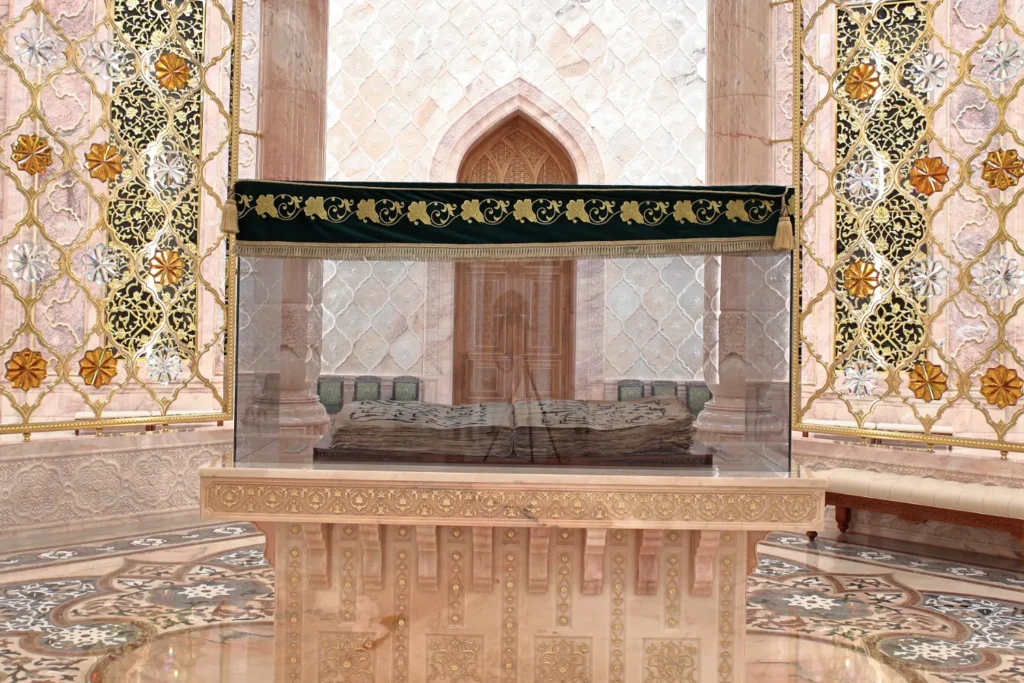
For pilgrims, these are places of profound spiritual encounter; for scholars and travelers, they offer the opportunity to see how the sacred text has passed through the centuries in its authentic form.
The Quran of Uthman
Also known as the Tashkent or Samarkand Quran, this manuscript mus’haf – a handwritten copy of the Quran – is regarded as one of the earliest surviving copies of the Holy Scripture. Its creation is traditionally dated to the 7th century, during the reign of the third Rightly Guided Caliph, Uthman ibn Affan. Written on parchment in early Hijazi script, the text reflects the formative period of Quranic written tradition.
Islamic tradition associates the manuscript with a dramatic chapter of history: it is believed that Caliph Uthman was assassinated while reading the Quran, and traces of his blood are said to remain on a verse of Surah Al-Baqarah. The journey of the mushaf has been far from simple. In the 14th century, it was brought to Samarkand by order of Amir Timur; during the Russian imperial period, it was transferred to St. Petersburg, before being returned to Tashkent in the early 20th century. Over time, it was kept in religious and museum collections before taking its place in the exhibition of the Center of Islamic Civilization.
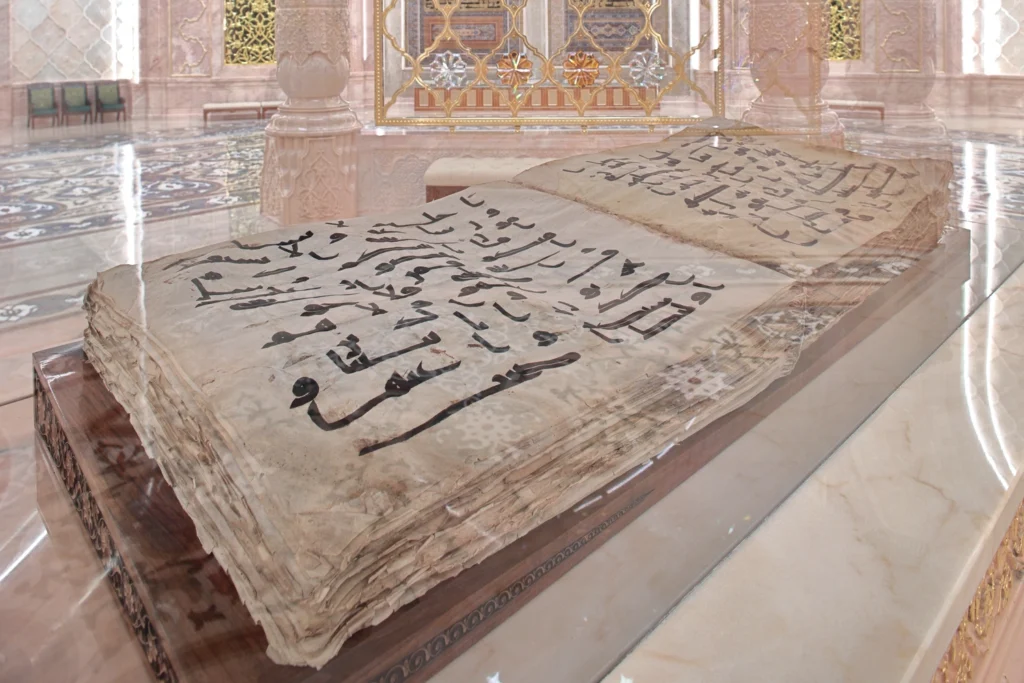
Photo: Press Service of the Muslim Board of Uzbekistan
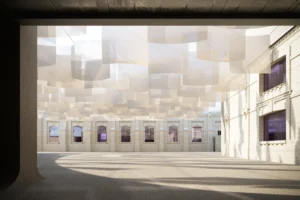
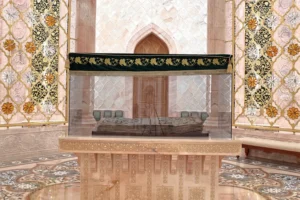
Today, the Quran of Uthman is displayed in a specially equipped gallery where the conditions necessary for preserving the ancient parchment are ensured. Alongside it are other manuscript Qurans, allowing visitors to trace the evolution of calligraphy and book culture across centuries.
Its inclusion in UNESCO’s Memory of the World Register has affirmed its global significance. It is now regarded both as a sacred relic inseparably linked to the country’s history and religious tradition, and a key source for understanding the early history of the Quran.
The Katta Langar Quran
The Katta Langar Quran, preserved in the library of the Muslim Board of Uzbekistan, is another of the world’s most ancient Quranic manuscripts. It takes its name from the Langar Ota Mosque in the Kashkadarya region, where its pages were safeguarded for centuries by a local Sufi community.
Scholars date the manuscript to the final quarter of the 8th century – a dating has been confirmed by paleographic and radiocarbon analysis, as well as by international research scientific expeditions. Ninety-seven pages of the Quran have survived to the present day – remnants of a once complete manuscript, fragments of which are now held in Uzbekistan and Russia.
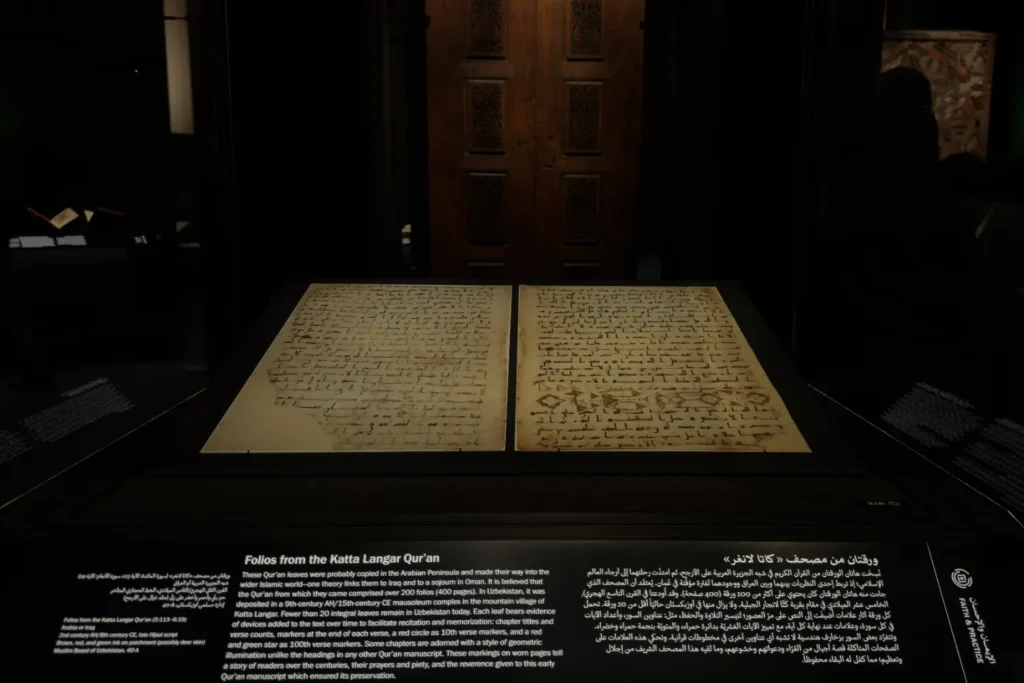
Photo: Press Service of the Muslim Board of Uzbekistan
Written on large-format parchment in early Kufic-Hijazi script, with later additions, the manuscript bears a binding dating to the 14th century, which has undergone several restorations. In recent years, the Katta Langar Quran has been comprehensively restored with the involvement of both international and Uzbek specialists. It has since been presented at major international exhibitions, including shows in Paris and Jeddah.
Today, the Katta Langar Quran remains one of the country’s most revered spiritual relics and an object of sustained interest for the global scholarly community.
The material was published in Travel+Leisure Central Asia magazine (February-March 2026)