
Eastern Kazakhstan—a land where mountains rise into the clouds, steppes gently merge into forests, and rivers reflect the sky so vividly that it feels as though one is gazing into infinity. The Altai is a mountain massif shared by Kazakhstan, Russia, China, and Mongolia. Katon-Karagai National Park, the largest in the country, is inscribed on the UNESCO list. In 2024, it was recognized as one of the world’s finest examples of sustainable tourism at the Green Destinations Awards in Berlin.
A City of Rivers, Metal, and Wind
Members of our group came together from Almaty, Astana, and Tashkent. In Ust-Kamenogorsk, we were greeted by a cool wind and a gray sky—thus began our expedition. Together with the M-sunrise.kz team, we loaded our luggage into three off-road vehicles and set out on our journey.
Ust-Kamenogorsk is a city of factories and rivers, where the air is heavy, carrying the scent of metal and dampness. It grew at the confluence of the Irtysh and Ulba rivers, on the site of an old outpost founded in 1720. Beneath its surface lie polymetallic deposits—the birthplace of the region’s metallurgical industry. Today, the city is home to about 400,000 residents.
We stopped at the embankment of the Strelka neighborhood, where the two rivers meet, before continuing eastward. Outside the windows flashed fields of sunflowers and wheat, damp meadows, and soon the first hills appeared. We paused at the Georgian Restaurant campsite—from here, the dense forests began. We had a quick meal, put on our jackets, and set off again.
We stopped at the embankment of the Strelka neighborhood, where the two rivers meet, before continuing eastward. Outside the windows flashed fields of sunflowers and wheat, damp meadows, and soon the first hills appeared. We paused at the Georgian Restaurant campsite—from here, the dense forests began. We had a quick meal, put on our jackets, and set off again.
Rivers, Hydropower Plants, and the Bukhtarma Reservoir
Eastern Kazakhstan is the most water-abundant region of the country. A cascade of hydroelectric power stations has been built here, and in the 1960s the Bukhtarma Reservoir—one of the largest in the world—was created. Stretching for nearly 500 kilometers, it seemed to accompany us throughout the entire journey.
The gray ribbon of asphalt wound between hills dotted with poplars and birches, then descended toward the meadows. In the 18th century, the first beehives were brought here, and the local honey quickly gained fame—it was even sent to the Romanov royal family.We arrived at the viewpoint on the Osinovsky Pass, where a photo zone marked ALTAY with a piano has been installed. It was created by M-sunrise.kz, a company founded by the Deriglazov brothers. They began with small audio kiosks, later forming the Meloman group of companies, and today they are developing domestic tourism, building cozy guesthouses across the region.
The road to the pass was constructed manually in 1940, in a mere 42 days. In spring, rare plants bloom here, while in winter avalanches are frequent. After the hydroelectric plant was built, recreational resorts began to appear along the reservoir’s shore, drawing people to the water.
The Blue Bay became particularly beloved—a serene spot dotted with dozens of holiday lodges among the pines. Once, jet-powered Meteor hydrofoils plied these waters, ferrying passengers to remote villages. We had to postpone our boat ride as the wind rose, the sky darkened, and rain poured down.
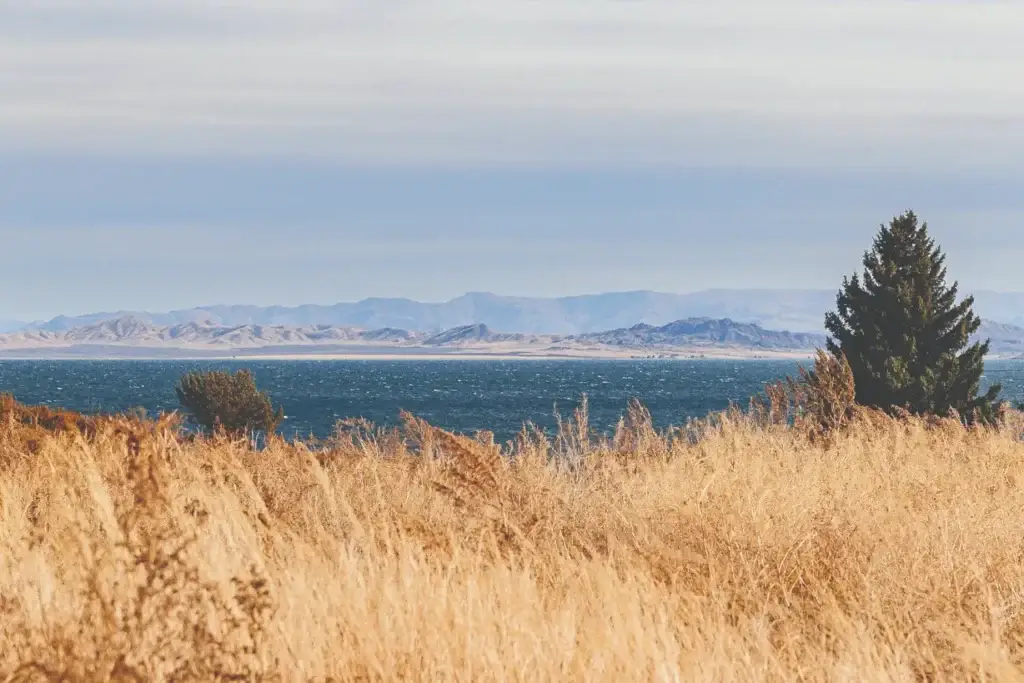
Photo: Kazakh Tourism
Cliffs and Pines: A Night by the Reservoir
By evening, we arrived at the Sunrise Skaly guesthouse. Along the way, we spotted a fox, disoriented by the headlights, darting along in front of the vehicles. At a roadside shop, we picked up snacks, kurt, and dried fish. At the guesthouse, a table was laid out in the spacious common area. Among the abundance of dishes, the fish stood out—pink trout and tender hot-smoked peled, both farmed in the reservoir. After dinner came a floating sauna, steam, icy water, and birch whisks.
In the morning, the bay was shrouded in mist, yet the guesthouse itself, snugly nestled among granite cliffs and pine forests, already gleamed with quiet splendor. “We breakfasted at a wooden table, on benches warmed by the morning sun. Local cats wound around our feet. On the table lay eggs fried to golden edges, thick fresh cream, soft bread, berry preserves, and honey exuding a delicate floral aroma. Coffee from the espresso machine felt like a luxury—steaming, crowned with a fine crema,” described our editor-in-chief, Barno Ikramova, in her essay.
Sunflowers, Herds, and Fertile Land
After breakfast, we set off along the right bank of the reservoir. The slopes were adorned with fields of sunflowers, while herds of horses and flocks of sheep wandered across. The soil here is fertile: Eastern Kazakhstan is one of the country’s major producers of sunflower oil, and the golden fields have become a signature feature of the region. In the village of Ulken Naryn, we visited the Tourist Information Center. “The summers here are hot, and all facilities for beach recreation are available. In Katon-Karagai, with its forested mountains, activities such as road tourism, hiking, mountaineering, and rafting are well developed,” noted the center’s guide.
Next, our route led to Katon-Karagai. At the entrance, framed by the snow-white peaks of the Sarymsakty Range, we were greeted by a monument to Karatay Batyr—a military commander who defended these lands from the Dzungars. His descendants still live here today. According to the program, we were scheduled for rafting on the taiga river Bukhtarma. However, as the weather turned foul, only a few dared to set out in inflatable rafts. At the rafting camp, a wood-fired field sauna awaited those who braved the river.
A Mountain Apiary: Life at 1,800 Meters
Next, we traveled to the village of Moilyldy, to visit the apiary of Sergey Nikitin. In the 18th century, Old Believers fleeing the reforms of Patriarch Nikon settled here. They were in search of the mythical Belovodye, their own Shambhala, yet they remained in this place.
We were treated to borscht, mashed potatoes with cutlets, grayling, baursaks, fresh cream, and kumis. Sergey recounted how he had purchased a house in this dying village, where the school and medical post had closed, leaving only seven inhabited homes. He had established the highest-altitude apiary in the region—perched at 1,800 meters. “I transport the hives up Mount Aktomar (Shchebenyukha), where there are abundant medicinal nectar plants and, on top of that, breathtaking 360-degree views. You can see the twin-peaked highest summit of the Altai and Siberia, Muztau (Belukha), as well as the Listvyaga and Tarbagatai ranges. In summer, I host visitors and rafters. My plans include building small bee houses and organizing snowmobile tours in winter. It’s very quiet here, no mobile reception,” shared Sergey Vasilyevich. “Now, try the honey straight from the frame,” he added, placing a dessert on the table—a tray of honey-filled combs.
We spent the night at the Yasnaya Polyana estate, nestled at the foot of the Altai Mountains, not far from the border village of Uryl. “My wife and I,” the owner, Andrey Pilipenko, recounted, “visited Katon in the 2000s to take antler baths and fell in love with this region. Our friend, father Seraphim, pointed to this meadow and said, ‘What a bright, clear place.’ Without much hesitation, we acquired the land. We wanted, like Leo Tolstoy, to live in an estate of the same name and devote ourselves to creativity. I carve wooden sculptures, invite artisans, and have even opened a souvenir shop.”
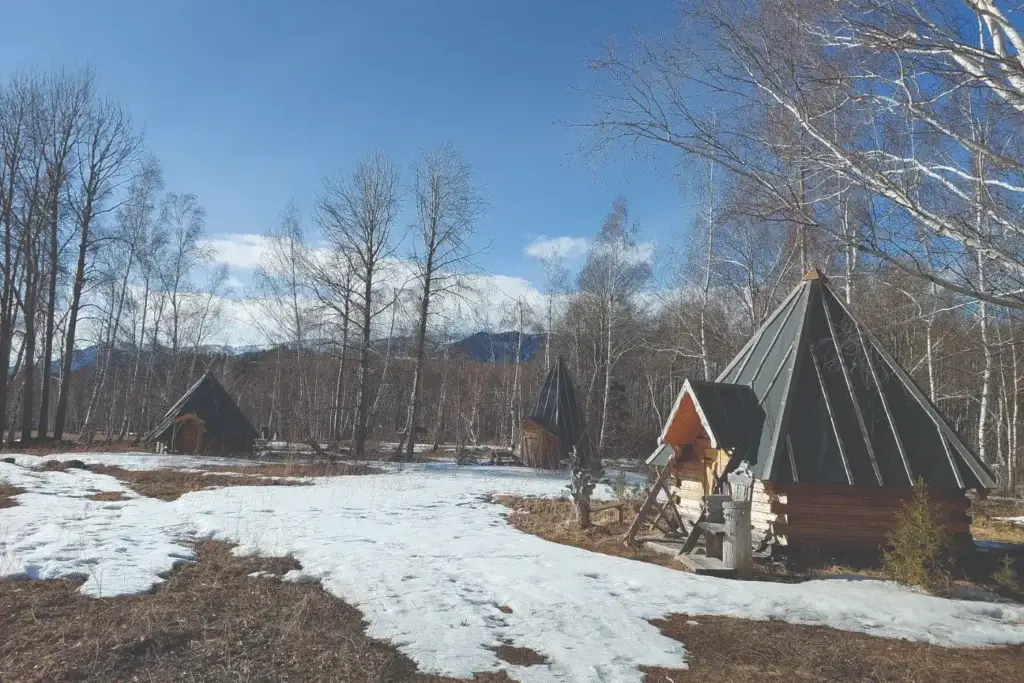
The wooden ails are traditional Altai dwellings. Nearby stand a Russian log-house museum, a meditation and massage hall, a workshop, a museum-dining hall, and a shed with goats. Inside the guest houses, one finds antique utensils, wooden sculptures, and protective charms imbued with the spirit of the Altai. After dinner, we headed to the sauna, where a veranda offered a samovar, bagels, fragrant honey, and jam. Guests could choose a fir-scented steam bath or immerse themselves in a herbal soaking tub.
The next morning, we visited the Berel Museum-Reserve, home to royal kurgans from the 5th–4th centuries BCE of the Scytho-Saka era. Archaeologists here discovered the burial of an ancient Altai chieftain. The ice preserved artifacts dating back 2,500 years. According to research, the Altai is the cradle of Turkic peoples.
Our journey continued to the radon springs of Rakhmanovskie Klyuchi and to Lake Karakol Yazevoye. From there, one can reach the Kokkol Waterfall, an abandoned mine, the sacred site of Kindik-Tas, and the base camp for climbers ascending Muztau (Belukha). In Uryl, we visited Dmitry Serov’s phyto workshop, sampling honey-and-berry blends and cedar oil, and purchasing teas and souvenirs.Lunch was served at Yasnaya Polyana’s “Berloga” dining hall. Like a museum, it displayed utensils and photographs of Katon-Karagay from the 19th–20th centuries, creating an authentic atmosphere. The menu featured home-style dishes, including options for vegetarians.
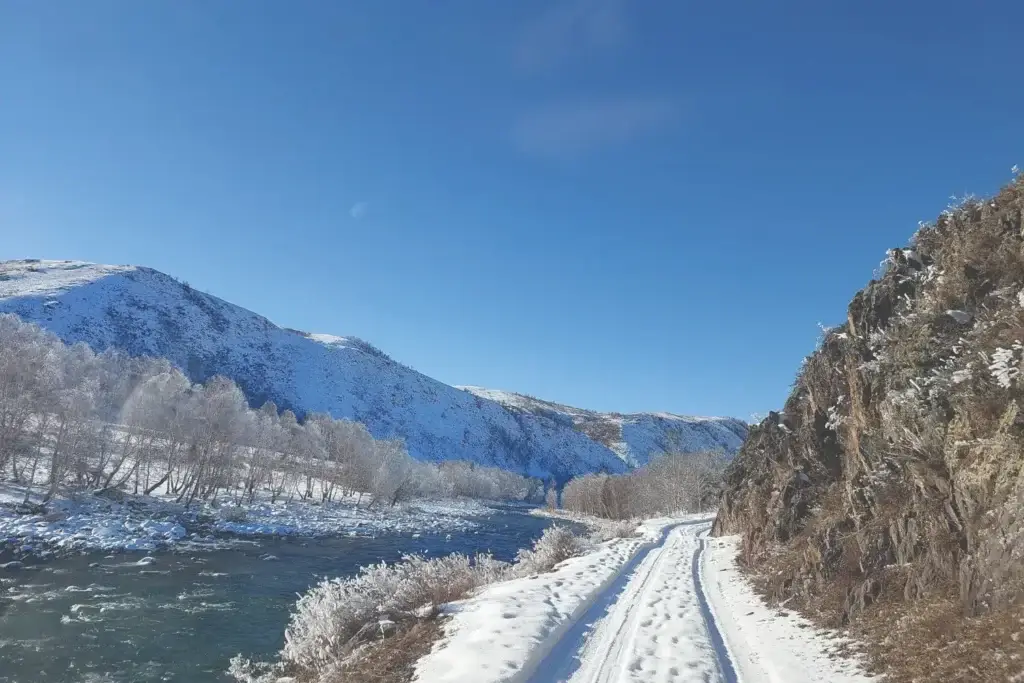
Photo: Rinat Mukataev
The Burkhat Pass and Traces of the Silk Road
After lunch, we set off for the Burkhat Pass, which links Katon-Karagay with the Markakol Nature Reserve. The road climbed in a winding serpentine. On one side, a deep precipice; on the other, sheer mountains covered with larch, cedar, and fir. “When venturing into the wilderness,” I said firmly, “one must make an offering to the local spirits—usually sweets or milk—and be in good spirits oneself.”
At the summit of the 900-meter-high mountain stands a viewpoint overlooking the Bukhtarma Valley. The path leading to it was once part of the Great Silk Road. The road was built by Austrian prisoners, and legend has it that the grandfather of film actor Arnold Schwarzenegger may have been among them.
At the base, we were greeted with dinner, a sauna, and a deep night’s sleep. In the morning came breakfast, a photo session in costumes styled after shamanic attire, and the journey back. In Katon-Karagay, we stopped at the Ak-Kayin maral farm. The farm’s owner led us to the enclosure with marals. As early as the 19th century, Old Believers began breeding these deer for their velvet antlers, used in infusions and baths. We fed the calves and a bull with its antlers removed. Along the way, I pointed out Scythian kurgans, a kymyskhan—a place where mares are milked and kumis is made—and the construction site of the new international airport. The drivers also shared stories and local legends, which could be heard over the radios.
We reached the opposite shore of the reservoir by ferry, experiencing every emotion of a corsair: the rocking of the boat, splashes of water, and the cries of gulls. The shore greeted us with sand of a striking yellow hue and dunes. We drove through the Samarsky District toward the Kurchum Bridge—the longest in Kazakhstan—which connects three districts and has significantly improved local logistics. The road along the left bank of the reservoir revealed cliffs crowned with pine forests, the mysterious Taintin Lakes, endless fields of farmland, and the Umys Pass. In Ust-Kamenogorsk, dinner awaited us at the Qurt & Wine House of Kazakh Cuisine.
The next morning, part of the team flew to Astana, while the rest set out on a tour of the ethnographic park. The country is home to over 120 ethnic groups, and to foster national unity, the Small Assembly of the Peoples of Kazakhstan was established in 1992. Ten years later, under the guidance of director Nikolai Zaitsev, an ethnovillage was constructed. The village features traditional dwellings and household items of Caucasian, Slavic (Russian, Ukrainian, Belarusian), Korean, German, Jewish, and Kazakh peoples. We explored the exhibition dedicated to the Kazakh poet Abai Kunanbayev. A winding path led us to a small zoo, where enclosures housed the fauna of East Kazakhstan: bears, wolves, wild boars, deer, waterfowl, and vultures.
The tour had come to an end. We had witnessed the steppes and mountains, rivers and deserts. East Kazakhstan, of course, is not about luxury and five-star hotels. Its true wealth lies in the ringing, magical silence, the scent of wild grasses, the murmur of mountain rivers, and in the people who preserve the nature and culture of this land. Katon-Karagay is the heart of this region, where rural tourism helps safeguard its unique biodiversity and offers visitors a chance to experience the pristine beauty of the multifaceted Altai.
The tour was organized by the Ministry of Tourism and Sports of Kazakhstan with the support of Air Astana.