
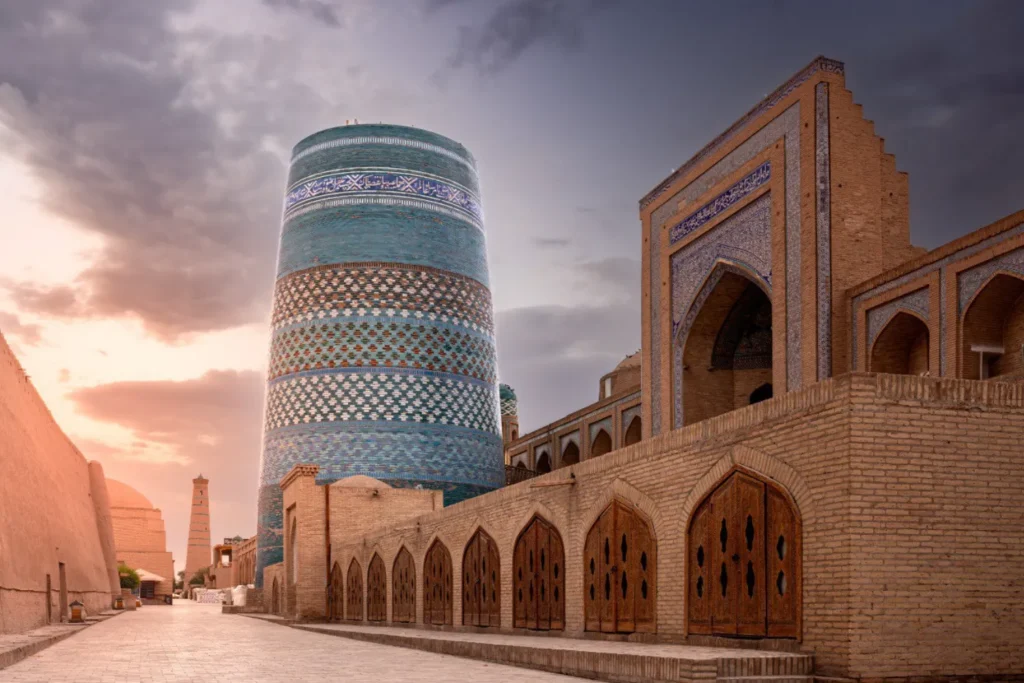
The ancient city, more than 2.5 thousand years old, is located on the border of the Karakum and Kyzylkum deserts. A walk through Ichan-Kale, a walled inner city, plunges into almost complete silence: narrow streets, sandy alleys, small squares and gilded wooden doors create the feeling of a place where history exists by itself.
In the 21st century, such cities are rarely left out. Khiva, an important point on the Great Silk Road, is still inferior to Samarkand and Bukhara in terms of tourist flow, but the situation may change. This year, it is planned to launch a high-speed train between Tashkent and Khiva, which will reduce travel time from 15 to seven hours. According to the author of the publication, this can significantly affect the future of the city.
Almost all the architectural monuments of Khiva are concentrated inside Ichan-Kala, an open–air museum. The madrasah of Muhammad Amin Khan, built in the middle of the 19th century, opens behind the Western Gate. Nearby is Kunya Ark, the khan’s palace with a mosque, a residence, a palace kitchen and a harem connected by a network of hidden corridors. Despite the brutality of the Khan’s rule, the architecture of the complex is distinguished by its elegance: the facades are decorated with niches and complex geometric ornaments in blue and turquoise tones.
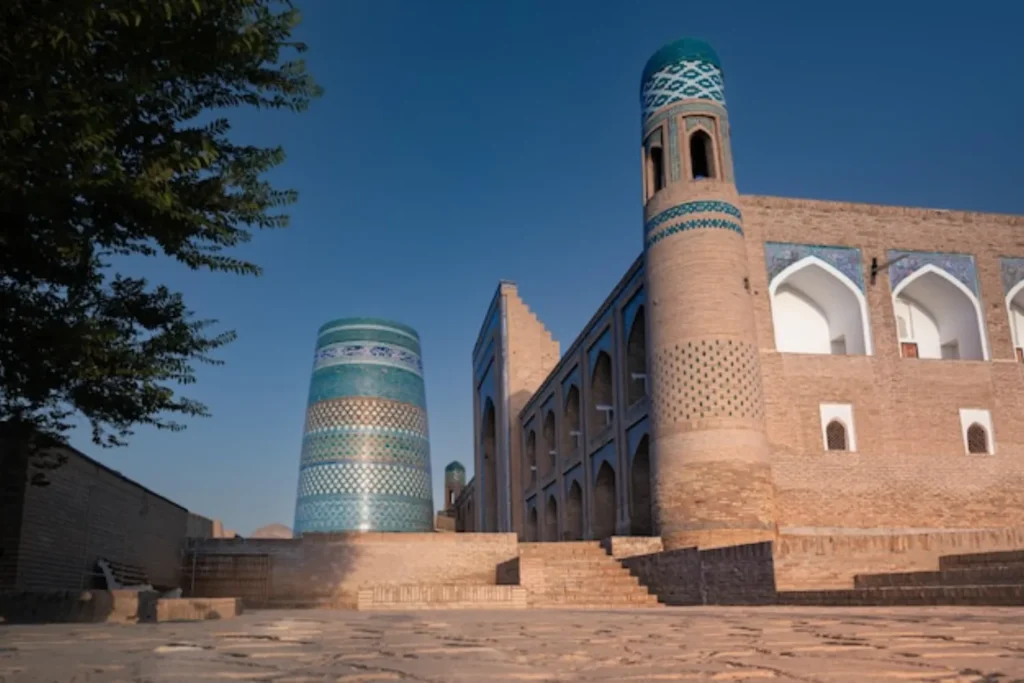
There is a square in front of Kunya Ark, where executions were once held. Today it has become a place for walks and photographs against the backdrop of the Muhammad Rahim Khan Madrasah, built in 1871.
The history of Khiva goes deeper than the Islamic period. Before the arrival of the Arabs in the 8th century, Zoroastrianism existed here for almost two thousand years. Its traces have been preserved in architecture, including in the form of symbolic crosses on the walls and a Zoroastrian fire pit, later turned into a well.
One of the rarest monuments of the city remains the 10th-century Juma Mosque, a rectangular wooden building supported by more than 200 columns, some of which are thousands of years old. It provides a rare insight into early Islamic architecture.
Khiva is ideal for hiking: all key attractions are within walking distance. At the beginning of the 20th century, Islam Khoja madrasah appeared here, the first Russian language school in the city, which became a symbol of the reforms and the beginning of the end of the khanate. Soon after the murder of Islam Khoja, the khanate was liquidated, and Ichan-Kala turned into a kind of time capsule.
Today, Khiva remains a city without mass tourism, where the past is felt especially acutely. However, with the launch of new trains, this silence may become a thing of the past.